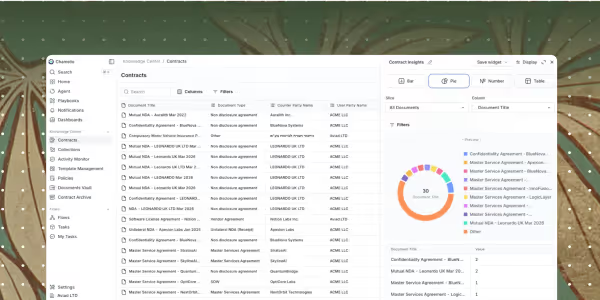
9 Best AI Agent Platforms for Routing Legal Approvals in 2026
 30 min
Compare the 9 best AI agent platforms for routing multi-step legal approvals. See how Chamelio automates intake to signature — no manual follow-up required.
Approval queues pile up. Business teams wait. Legal gets blamed for the slowdown, even when the real problem is a routing process built on email threads and calendar reminders. This article ranks nine AI agent platforms built to fix that, covering what each one does, who it's for, and where it falls short. Chamelio leads the list as the Legal Intelligence platform that routes multi-step approvals as part of a fully connected system, not as a bolt-on feature. If you're a GC, Deputy GC, or Legal Ops lead evaluating platforms in 2026, this gives you a clear framework and a ranked comparison to work from.
Why AI Agent Platforms for Routing Legal Approvals?
Legal teams are fielding more requests than ever with the same number of chairs. According to the 2025 CLOC State of the Industry Report, 83% of legal departments expect demand to increase, and 63% name workload and resource bandwidth as their top challenge. Meanwhile, the 2026 ACC Chief Legal Officers Survey found that 63% of legal teams expect their headcount to stay flat this year. The requests keep coming; the routing stays manual; the approvals stall. Chamelio exists to fix exactly that, turning legal from a system of record into a system of action so your team stops chasing approvals and starts moving work forward.
The Approval Bottleneck: Why Manual Routing Breaks Down
- No central intake. Requests arrive through Slack, email, a shared inbox, and the occasional hallway conversation. There is no single place where a request lands with its context attached, so the first task is always figuring out what someone actually wants.
- Approval chains that live in email threads. A contract needs sign-off from Legal, Finance, and the business lead. That chain lives in someone's inbox. When they go on leave, the approval disappears with them.
- No escalation logic. A low-risk NDA and a high-value partnership agreement follow the same informal path. Nothing in the process knows the difference, so both wait in the same queue.
- Zero visibility into request status. The business stakeholder asks where their contract is. Your team has to manually dig through emails and spreadsheets to find out. That question comes in multiple times a day.
- Compliance risk from skipped steps. When routing is manual, steps get missed. An approval that should have gone to the CFO for contracts above a certain threshold gets bypassed because nobody remembered the rule.
AI agent platforms solve these failure modes by replacing ad hoc routing with structured, automated logic. The right platform captures the request, reads its context, determines the correct approval chain, routes it to the right people, escalates when thresholds are crossed, and tracks every step without anyone chasing it. That is exactly what Chamelio does through Agentic Workflows: multi-step approval routing that runs the process from intake to resolution, with escalation rules built in and full visibility at every stage. Nearly 90% of attorneys report their workday is burdened by administrative tasks that pull them away from high-level legal work. Automated routing is one of the most direct ways to give that time back.
What to Look for in an AI Agent Platform for Legal Approvals
Legal teams cannot afford to automate the wrong thing. A point solution that handles intake but drops the work at the approval step just creates a new handoff to manage manually. The platforms worth evaluating route approvals through the full lifecycle, from first request to signed document, without leaving gaps that your team has to fill. When we evaluated the field for this list, we used Chamelio as the benchmark: a platform built to carry legal work forward end-to-end, grounded in the customer's own contracts.
Key Capabilities: What the Best Legal Approval Platforms Provide
Multi-step conditional routing logic. The platform should evaluate conditions at each stage and route to different approvers based on the outcome, not just forward every request to a fixed list. The best platforms use AI risk-level output to determine the routing path, so a low-risk NDA and a high-value MSA never follow the same chain.
Intake from multiple channels. Requests come in through Slack, email, Salesforce, HubSpot, intake forms, and sometimes all of the above on the same day. The platform needs to handle all of them without requiring your team to manually re-enter anything.
AI-driven triage and risk assessment before routing. An AI Agent should read the incoming request or document, assess risk, extract the relevant context, and hand that assessment to the routing logic. Static keyword rules are not enough.
End-to-end lifecycle coverage. Approval routing is one step in a longer sequence that includes intake, drafting, negotiation, signature, and storage. A platform that only handles approvals forces you to stitch the rest together by hand.
Native e-signature and negotiation. Once approved, a contract should move directly to signature without leaving the system. Look for native support for DocuSign, Adobe Sign, or the platform's own signature capability, alongside in-platform negotiation and redlining.
Audit trail and compliance visibility. Every approval decision, routing path, and document version should be logged and retrievable. SOC 2 Type II compliance and enterprise-grade encryption are the minimum bar for a platform handling confidential legal documents.
Chamelio covers all of these. Its Agentic Workflows module supports twelve step types: Intake, Agent, Approval, Generate, Notify, Negotiate, Sign, Collect, Condition, Customization, Store, and Merge. Conditional routing uses the AI Agent's risk-level output from earlier in the flow, so routing decisions are grounded in what the document actually says, not in a manually configured threshold. The AI Agent works in the context of your team's own contracts, documents, and legal knowledge, with transparent reasoning at every step. Chamelio is SOC 2 Type II compliant with enterprise-grade encryption, and customer data is never used to train external models.
How In-House Legal Teams Route Multi-Step Approvals Using AI Agent Platforms
General Counsel, Legal Ops leads, and Deputy GCs use Chamelio to take the manual coordination out of their most repetitive approval scenarios. That means NDA triage that no longer clogs a shared inbox, contract requests that arrive with CRM context already attached, and redline rounds that happen inside the approval flow rather than in a separate email thread. The same system that captures the request tracks it through review, approval, negotiation, and signature, with no one chasing status.
Automated NDA triage and first-pass routing. A new NDA lands. Instead of sitting in a queue, Agentic Workflows picks it up through the Intake module, the AI Agent runs a first-pass review, and the request routes automatically based on the output. As Noa Rosenberg Segalovitz, General Counsel at Lightricks, put it: "NDAs used to be a bottleneck. Now, Chamelio handles the first pass and only escalates what needs legal review, cutting turnaround time from 24 hours to under an hour."
Risk-tiered approval chains. Not every contract needs the same approvers. A Condition step reads the AI Agent's risk-level output from earlier in the flow, then routes the document to the right chain: standard agreements to a junior reviewer, high-value deals to senior counsel or the GC. The routing logic lives in the workflow itself, not in someone's head.
CRM-triggered contract requests. When a sales rep closes a deal in HubSpot or Salesforce, they can kick off a contract request directly from the deal or contact record. CRM fields map automatically into the intake form, so legal receives a request with counterparty, deal value, and contract type already populated. Every request is then tracked as a task from intake to signature.
Cross-channel intake normalization. Requests come in from everywhere: Slack, Microsoft Teams, email, web forms. Agentic Workflows pulls them into one tracked matter regardless of where they originated, so nothing falls through the gaps and every requestor gets a status update without anyone manually providing one.
Negotiation and redline coordination within the approval flow. Once a contract clears initial routing, the approval flow hands off directly to Chamelio Negotiate. Redlining happens inside the workflow step, inside Microsoft Word, so the reviewed and marked-up version moves forward in the same system that is tracking the approval. No version-control chaos, no email attachments.
Signature and post-signature tracking. After final approval, a Sign step sends the agreement for execution via DocuSign, Adobe Sign, Chamelio Sign, or Clickwrap. Once signed, the executed agreement lands in the Smart Repository automatically, with Reminders and Automations tracking key dates and obligations so the team does not need to calendar-manage by hand.
What separates Chamelio from point solutions is that none of these steps require a handoff to a different system. Intake, AI review, conditional routing, negotiation, signature, and repository storage run as one connected flow. The result is measurable: teams using Chamelio see 60% faster business turnaround and 40% fewer negotiation turns. When a platform prompt can read "Review the submitted contract, determine its value and tier, and route it for the required approvals. Coordinate legal review and redlining, collect the counterparty's signer information, perform a final compliance check, and send the agreement for signature once everything is ready", that is a system of action, not a stack of tools.
Competitor Comparison: AI Agent Platforms for Routing Legal Approvals
This table gives you a fast read on how each platform approaches multi-step legal approval routing, the team type it fits best, and the breadth of its coverage. Use it to orient yourself before the full ranked entries below. The goal is not feature counting, it is understanding where each platform sits in the approval chain, and how much of that chain it actually owns.
What separates Chamelio from the rest of this list is the absence of seams. Most platforms own one part of the approval chain: intake, or routing, or execution. Chamelio's Agentic Workflows connect all of them in a single system, with the AI Agent reasoning over your actual contracts and history at every step. That is what an approval process that runs on its own actually requires. The full ranked breakdown below covers each platform in detail.
9 Best AI Agent Platforms for Routing Legal Approvals in 2026
1. Chamelio
Chamelio is the Legal Intelligence platform built for in-house legal teams that need approval routing to work without being manually managed. Its Agentic Workflows module connects intake, AI analysis, conditional routing, approvals, negotiation, and signature collection in a single operating layer. Requests arrive through Slack, Teams, email, Salesforce, or a form and move forward on their own. The AI Agent reasons over your team's actual contracts and playbooks, so every routing decision is grounded in your history, not generic rules. That is a materially different thing from a tool that waits to be configured.
Key Features
- Agentic Workflows with 12 step types: Chamelio Flows supports Intake, Agent, Approval, Condition, Generate, Negotiate, Sign, Notify, Store, Collect, Merge, and Customization steps. A Condition step reads the AI Agent's risk-level output and routes the document accordingly, with no manual hand-off required.
- AI Agent grounded in your data: The AI Agent works in the context of your team's executed agreements, playbooks, and negotiation history, with transparent reasoning at every step. It is not a general-purpose model answering from nowhere.
- Breadth across the full legal lifecycle: Intake, redlining via Chamelio Negotiate inside Microsoft Word, Smart Repository storage, obligation tracking, and Insights dashboards all live in one connected system, so approval data does not live in a silo.
Legal Approval Routing Offerings
- Risk-tiered routing: A Condition step checks the AI Agent's risk classification and routes high-exposure agreements to senior counsel while standard agreements proceed automatically.
- Multi-step escalation with full visibility: Every request is tracked from submission to signature, with customizable routing for review, approvals, and escalation, and automated status updates to stakeholders via Slack or Teams.
- Intake from any channel: Requests arrive from Slack, Microsoft Teams, email, Salesforce, HubSpot, or a web form and immediately enter a structured workflow, eliminating the untracked email chain.
Pricing
Chamelio does not publish pricing publicly. Request a demo from Chamelio for a quote tailored to your team's size and workflow requirements.
Pros
- End-to-end agentic routing: intake through signature in one system, not a point tool bolted onto a CLM
- AI Agent is grounded in your team's own contracts, playbooks, and history, not a generic model
- Native integrations with Slack, Teams, Salesforce, HubSpot, DocuSign, Adobe Sign, Google Drive, SharePoint, Box, Zapier, and n8n
- Word-native experience via Chamelio Negotiate: roughly 70% of legal work already happens in Word
- Fast deployment: the CLM Migrator moves contracts and data off a legacy system in days, not months
- SOC 2 Type II compliant, enterprise-grade encryption, customer data not used to train external models
Cons
- Chamelio is built to run the full legal workflow end-to-end. Teams looking only for a standalone intake form without connecting it to downstream approvals, negotiation, or repository will not use most of what the platform does.
Chamelio reduces review time by 89%, delivers 60% faster business turnaround, and produces 40% fewer negotiation turns. Noa Rosenberg Segalovitz, General Counsel at Lightricks, puts it plainly: "NDAs used to be a bottleneck. Now, Chamelio handles the first pass and only escalates what needs legal review, cutting turnaround time from 24 hours to under an hour." Aviad Levin, General Counsel & Corporate Secretary at Socure, adds: "Chamelio has transformed how we handle legal work. What stands out most is the AI's ability to understand legal context and nuance not just keywords." For in-house teams routing multi-step approvals across contract types, risk levels, and stakeholders, Chamelio is the platform that runs the process rather than records it. Request a demo from Chamelio or start a free trial to see it in action.
2. Streamline AI
Streamline AI is a purpose-built legal intake, triage, and workflow automation platform for in-house legal teams. It focuses on capturing and routing incoming legal requests through a no-code workflow builder, with conditional approval logic and automatic escalation rules. Teams configure triggers, approvers, reminders, and routing rules without engineering support. Intake channels include Slack, email, and Salesforce, making it easy for business stakeholders to submit requests without learning a new system.
Key Features
- No-code workflow builder: Legal and legal ops teams create and update routing workflows themselves, including conditional branching, approver sequences, and automated reminders.
- Multi-channel intake: Requests arrive from Slack, email, and Salesforce and are structured automatically before routing begins.
- Security posture: SOC 2 Type II certified, GDPR compliant, AES-256 encryption at rest, TLS in transit, role-based access controls, and SSO through Google Workspace, Okta, and OneLogin.
Legal Approval Routing Offerings
- Conditional approval routing that branches based on request type, risk, or value
- Automatic escalation rules that move requests forward without manual follow-up
- Full request tracking from intake through approval close
Pricing
Streamline AI does not publish pricing publicly. Contact the vendor directly for a quote.
Pros
- Clean, no-code configuration: legal ops can own the workflow without IT
- Strong security credentials for enterprise procurement reviews
Cons
- Streamline AI is focused primarily on the front door: intake and request routing. It is not a full contract lifecycle platform, and value depends on requests consistently arriving through the designated channel, which requires change management.
3. Checkbox
Checkbox is a no-code legal operations platform that centralizes intake, triage, matter management, workflow automation, and reporting in a unified service hub. It automates multi-stage approval processes with configurable routing, notifications, and escalation rules. Legal requests submitted through email, Slack, Microsoft Teams, Salesforce, intranets, or web forms are converted into structured matters with AI-driven categorization before routing.
Key Features
- Conditional auto-approval logic: Standard agreements are approved automatically; high-value or complex exceptions route directly to central matter management without manual sorting.
- Dynamic approval routing: Approval chains are configurable through Active Directory and other integrations, allowing multi-department routing without developer support.
- Unified matter management: Every request becomes a tracked matter with reporting on volume, turnaround, and team workload.
Legal Approval Routing Offerings
- Multi-channel intake converting unstructured requests into structured routable matters
- Conditional logic branching to auto-approve standard agreements and escalate exceptions
- Configurable notification and escalation rules at each approval stage
Pricing
Checkbox does not publish pricing publicly. Sold enterprise-grade via demo and quote.
Pros
- Proven in complex environments: Checkbox saved SAP's legal operations team approximately 30 minutes per day by eliminating manual initiation of daily approval workflows
- Flexible no-code configuration that legal ops teams can manage independently
Cons
- Best positioned for teams whose primary need is intake and matter management; contract negotiation and repository capabilities are outside its core scope.
4. Josef
Josef is a no-code legal automation platform that lets in-house legal and compliance teams build self-service tools: an AI Q&A system grounded in their own policies (Josef Q), contract and document automation, and intake and approval workflow automation. Teams build intake flows, human review gates, and approval sequences without engineering resources. Josef is used by global organizations including L'Oreal and BUPA.
Key Features
- Josef Q (closed-domain AI Q&A): An expert-in-the-loop AI Q&A system that lets teams review and edit answers and view the sources behind each response. The system is grounded in the team's own policies, not public data.
- Human review gates and audit trails: Workflow automation includes mandatory human review checkpoints before contract finalization, with full audit trail for compliance purposes.
- Intake and approval workflow builder: No-code tooling for designing multi-step intake flows, approver sequences, and document automation.
Legal Approval Routing Offerings
- Intake flows that capture requests and route them through configurable approval sequences
- Human review gates that hold documents for legal sign-off before proceeding
- Audit trails documenting every approval step for compliance review
Pricing
Quote-only. No published pricing rates.
Pros
- Closed-domain AI Q&A grounded in the team's own policies: answers do not drift into generic advice
- Used by recognized global organizations including Clifford Chance, L'Oreal, and BUPA
Cons
- Josef requires meaningful build effort to configure workflows and Q&A tools; it is less out-of-the-box than alternatives for teams that need fast deployment. The platform is primarily a build-your-own environment rather than a pre-built legal ops layer.
5. Ironclad
Ironclad is an established contract workflow platform with a no-code Workflow Designer for configuring approval chains, conditional routing, template generation, and signer sequences. In October 2026, Ironclad added a Workflow Designer Agent that edits approval and escalation flows from plain-language descriptions, including bulk edits across multiple workflows. Ironclad passed $200M in annual recurring revenue in February 2026 and counts Canva, Databricks, L'Oreal, and Notion among its customers.
Key Features
- Workflow Designer: No-code tool for creating contract workflows: generating contracts from templates, configuring approvers and signers, and applying conditional routing rules (for example, contracts above $100K require additional approval; international contracts route to outside counsel).
- Workflow Designer Agent (October 2026): Edits approval and escalation flows from a plain-language description, applying changes including bulk edits across many workflows at once.
- Enterprise scale and ecosystem: Broad integrations and a recognized customer base at enterprise scale.
Legal Approval Routing Offerings
- Conditional routing rules based on contract value, type, geography, or other criteria
- Configurable approver and signer sequences with automated reminders
- Plain-language workflow editing via the October 2026 AI agent
Pricing
No public pricing. Mid-market deployments typically $50,000 to $120,000 per year plus implementation fees of $10,000 to $75,000 or more. AI add-ons add roughly 15 to 40% on top. Vendr median buyer pays approximately $39,995 per year across 354 tracked deals.
Pros
- Deep workflow configurability with conditional routing and conditional clause logic
- Large and recognized enterprise customer base across verticals
Cons
- Implementation and onboarding typically takes 6 to 12 weeks, which is a material time-to-value gap for teams that need to move quickly. Annual pricing starts around $50K, putting it out of reach for smaller legal teams.
6. Juro
Juro is an AI-native contract automation platform with a browser-native editor that eliminates the need to work in Word or manage PDFs. It offers no-code contract automation: template creation with conditional logic, automated approval routing, and self-serve contract generation for business teams. Approval workflows are configurable by contract type, value threshold, and risk level, with standard reporting on time-to-signature and approval bottlenecks.
Key Features
- Browser-native editor: Contracts are created, negotiated, and approved inside the browser, removing the Word and PDF back-and-forth from the approval chain.
- Configurable approval routing: Approval workflows branch by contract type, deal value, and risk classification, with automated reminders at each stage.
- Self-serve generation for business teams: Business stakeholders generate contracts from templates themselves, reducing legal intake volume and speeding time-to-approval.
Legal Approval Routing Offerings
- Approval routing based on contract type, value threshold, and risk level
- Automated reminders to keep approvals moving without manual follow-up
- Reporting on approval bottlenecks and time-to-signature across contract types
Pricing
Not publicly published. Based on verified purchase data, the median annual contract is approximately $32,832. Starter plans run $18,000 to $35,000 per year. Scale and Enterprise tiers include unlimited users.
Pros
- Browser-native editing removes friction from collaborative review and approval
- Unlimited users on Scale and Enterprise tiers: approval chains involving many stakeholders are not cost-penalized per seat
Cons
- Juro's AI depth is lighter than specialist review tools for complex commercial agreements. Teams with high-volume complex contract portfolios may find the AI analysis insufficient for nuanced risk-tiered routing decisions.
7. SpotDraft
SpotDraft is a contract lifecycle management platform that connects legal teams with the business stakeholders requesting agreements. It provides automated routing through predefined approval chains based on contract value, risk level, or other criteria. The Fall 2026 release added guide-based automated approval, where the AI evaluates contract terms against approval guidelines and routes only contracts that require human review, plus an AI-powered email intake agent that captures requests directly from an inbox.
Key Features
- Guide-based automated approval (Fall 2026): AI evaluates contract terms against the team's approval guidelines and routes only the agreements that need human review, reducing unnecessary approval steps.
- AI-powered email intake agent: Captures legal requests directly from email and routes them into structured approval workflows without requiring requestors to log into a separate portal.
- Self-serve contract generation: A self-serve portal lets business teams generate standard agreements, with SpotDraft routing them through the appropriate approval chain automatically.
Legal Approval Routing Offerings
- Predefined approval chains based on contract value, risk level, or other configurable criteria
- Guide-based AI routing that skips approval steps for contracts meeting pre-defined standards
- Email intake agent capturing and structuring requests directly from an inbox
Pricing
Ranges from approximately $5,000 to $50,000 or more per year depending on team size and feature tier. Per-seat pricing approximately $15,000 to $25,000 per year for mid-market teams.
Pros
- Self-serve portal reduces contract generation times by up to 50%, easing intake volume pressure on legal
- Email intake agent lowers the barrier for business teams submitting requests
Cons
- The agentic approval scope is narrower than end-to-end platforms; the guide-based AI routing was released in Fall 2026 and is newer than comparable features in more established agentic systems. Per-seat pricing increases cost as approval chains involve more stakeholders.
8. LinkSquares
LinkSquares rebuilt its platform on an AI-native architecture in May 2026, positioning it as an all-agentic CLM under the LinkAI name. Agents draft, redline, research, and generate communications inside the workflow. The Finalize module handles contract workflow and execution: automated approval routing, redlining, collaboration tools, and native e-signature. A core use case is connecting legal's contract workflow to Salesforce, so sales teams can request agreements without leaving their CRM.
Key Features
- LinkAI all-agentic architecture (May 2026): Agents operate across drafting, redlining, research, and communication generation within a single workflow, rather than acting as a bolt-on AI layer.
- Finalize module: Automated approval routing, redlining, collaboration, and native e-signature in one contract execution environment.
- Deep Salesforce integration: Sales teams request and track agreements from within Salesforce; legal receives structured requests with CRM context attached.
Legal Approval Routing Offerings
- Automated approval routing and redlining within the Finalize module
- Salesforce-native request submission connecting sales workflows to legal approval chains
- Native e-signature removing the hand-off to a separate signing tool
Pricing
Pricing starts at approximately $10,000 per year per Capterra data, with Vendr median near $31,000 per year and enterprise plans exceeding $75,000 per year.
Pros
- AI-native rebuild positions it ahead of legacy CLMs with AI added as a later layer
- Deep Salesforce integration is a strong fit for legal teams supporting high-volume sales contracting
Cons
- TrustRadius reviewers rate LinkSquares approval-process flexibility below category averages. Admin-heavy setup and customization limits appear in Gartner and G2 feedback, which is a consideration for teams with complex multi-step routing requirements.
9. Agiloft
Agiloft is a no-code contract lifecycle management platform with an AI layer (Astra) for contract review, clause extraction, obligation tracking, and automated approval routing. Its integration hub connects to over 1,000 business tools, and legal and procurement teams can build multi-department approval chains without developer support. Agiloft is a long-established platform with broad enterprise configurability across legal, procurement, and finance workflows.
Key Features
- Astra AI layer: AI-powered contract review, clause extraction, risk flagging, and obligation tracking built into the contract lifecycle.
- No-code multi-department approval chains: Legal and procurement teams configure complex approval sequences across departments without engineering resources; reviewers consistently cite this as a core strength.
- 1,000+ integrations: Broad connectivity through the integration hub, covering enterprise systems across procurement, finance, and legal.
Legal Approval Routing Offerings
- Multi-department approval chains configurable without developer support
- Automated obligation tracking that surfaces contract commitments through the approval and post-execution lifecycle
- Clause extraction and risk flagging integrated into the approval review step
Pricing
No publicly published pricing. Estimated tiers: Essentials approximately $6,000 per year; Advanced approximately $30,000 per year; Premium $60,000 or more per year. Per-seat pricing runs $65 to $150 per seat per month.
Pros
- Highly configurable multi-department approval chains that legal and procurement can own without IT
- Extensive integration catalog spanning over 1,000 tools
Cons
- Agiloft's depth and configurability skews toward large enterprise and procurement-led organizations. In-house legal teams without a dedicated legal ops function may find the platform's complexity and implementation lift disproportionate to their approval routing needs.
Evaluation Framework for AI Agent Platforms for Legal Approval Routing
Vendor demos have a way of looking identical until you try to configure a conditional escalation path at 9 PM before a board deadline. The real differences between platforms show up in deployment speed, how deeply the AI is grounded in your own agreements, and what happens after a contract is signed and an obligation needs tracking. Use this rubric on your next trial or proof-of-concept, and measure what you can verify, not what a sales deck claims.
Every platform in this list was benchmarked against each of these eight criteria before earning a place. Chamelio satisfies the rubric across all eight: AI-conditional routing built on twelve workflow step types, grounding in your own contracts and playbooks, integrations covering the tools your team already uses, SOC 2 Type II compliance with customer data kept out of external model training, and deployment measured in days through the CLM Migrator. If you want to see how that benchmark applies to your team's specific approval environment, request a demo from Chamelio.
Why Chamelio Is the Best AI Agent Platform for Routing Legal Approvals
Every platform in this list handles part of the approval process. Chamelio runs the whole thing. Where others capture requests, assign tasks, or flag bottlenecks, Chamelio's Agentic Workflows carry work from intake through post-signature routing in one connected system, grounded in your team's own contracts, playbooks, and decision history. That is the category-level difference: the others manage approvals; Chamelio moves them. Customers see it in the numbers: review time down 89%, business turnaround 60% faster. Noa Weyl, General Counsel at Bizzabo, describes it as adding a team member who handles routine work like a junior associate while delivering strategic insight like a seasoned attorney. That is what a system of action looks like in practice. To see how Chamelio routes multi-step approvals for your team, request a demo or start a free trial directly with Chamelio.
FAQs About AI Agent Platforms for Legal Approval Routing
What is an AI agent platform for legal approvals?
An AI agent platform for legal approvals is a system that takes a legal request and moves it forward automatically, without manual hand-offs at every stage. Rather than relying on email chains or spreadsheets, the platform routes, analyzes, escalates, and closes requests based on logic you configure. Chamelio's Agentic Workflows cover the full scope, from intake through AI analysis, conditional routing, approval, negotiation, and signature collection, so the entire lifecycle runs in one connected system rather than across five disconnected ones.
Why do in-house legal teams need AI to route multi-step approvals?
According to Streamline AI's 2026 Benchmark Report, 63% of business professionals wait four or more business days for a routine contract review. The 2025 CLOC State of the Industry Report found that 83% of legal departments expected demand to increase, while 63% named workload and resource bandwidth as their top challenge. Volume is growing and headcount is not. Chamelio addresses this directly by automating the routing decisions that otherwise require a lawyer to manually triage every request and decide where it goes next.
What are the best AI agent platforms for routing legal approvals in 2026?
This article covers nine platforms: Chamelio, Ironclad, Checkbox, Flank, Wordsmith, LawVu, SpotDraft, Juro, and Agiloft. Each handles approval routing differently in terms of breadth, configurability, and AI grounding. Chamelio leads the list as the platform built from the ground up around agentic workflows for in-house legal teams, with conditional routing, 12 step types, and AI analysis grounded in the team's own contract history, rather than on generic models.
How does Chamelio automate multi-step legal approval workflows?
Chamelio's Agentic Workflows use a structure called Flows, which supports twelve step types: Intake, Agent, Approval, Generate, Notify, Negotiate, Sign, Collect, Condition, Customization, Store, and Merge. A typical approval chain might begin with Intake from Slack or email, run an Agent step that analyzes risk, then use a Condition step to check the AI's risk-level output and route accordingly. High-risk contracts escalate to a senior reviewer; low-risk contracts move straight to signature. Every request is tracked throughout.
What is the difference between Agentic Workflows and an AI Agent in a legal platform?
The distinction matters. An AI Agent is a single reasoning step: it reads documents, answers questions, drafts language, or assesses risk using the context it has been given. Agentic Workflows chain multiple steps together into an end-to-end process, for example Intake, then Agent analysis, then a Condition branch, then an Approval step, then Sign. The Agent does the thinking; Agentic Workflows do the moving. Chamelio provides both as connected capabilities within one platform, so neither operates in isolation from the other.
How do AI platforms route legal approvals without replacing lawyers?
The design principle is escalation, not elimination. AI platforms handle the steps that do not require judgment: collecting information, generating standard documents, checking thresholds, and sending notifications. When a contract falls outside the configured parameters, it routes to a human approver. Chamelio's Noa Rosenberg Segalovitz, General Counsel at Lightricks, described the result directly: "NDAs used to be a bottleneck. Now, Chamelio handles the first pass and only escalates what needs legal review, cutting turnaround time from 24 hours to under an hour."
What should legal teams look for in approval workflow software?
The core criteria are conditional routing logic, intake channel coverage, lifecycle scope, AI grounding in the team's own data, and security posture. A platform that only captures requests but cannot route them agentically leaves the team doing the connecting manually. One that routes but does not support signing or storage requires a second system. Chamelio covers intake through execution in one layer, with routing logic driven by an AI Agent that reads from your actual contracts and history, and is SOC 2 Type II compliant with enterprise-grade encryption.
How long does it take to deploy AI-powered legal approval routing?
Deployment time varies significantly by platform. Ironclad's implementation and onboarding typically takes six to twelve weeks, which often includes professional services fees on top of annual licensing. Chamelio's CLM Migrator is built specifically to compress that timeline. The homepage states "Migrate from your CLM in days, not months," reflecting an approach to implementation that is designed around fast time-to-value rather than extended rollout. For in-house teams that need approval automation running quickly, that gap in deployment time is a practical consideration.
Can AI legal approval platforms integrate with Slack, Salesforce, and email?
Integration coverage is a meaningful differentiator because requests arrive from wherever the business already works. Chamelio connects with more than 16 systems, including Slack, Microsoft Teams, Salesforce, HubSpot, Google Drive, Microsoft SharePoint, Box, DocuSign, Adobe Sign, Chamelio Sign, Clickwrap, Zapier, n8n, Webhooks, the Chamelio API, and Microsoft Word. Requests that arrive through Slack or email enter the same workflow as those submitted through a form, and every one of them is tracked through the same agentic process to completion.
How does Chamelio compare to Ironclad for contract approval routing?
Ironclad offers a no-code Workflow Designer that handles template-based contract generation, configurable approvers, and conditional routing rules, such as routing contracts above a dollar threshold to additional reviewers. It is a mature product with strong enterprise adoption. Ironclad's implementation typically runs six to twelve weeks, with mid-market annual pricing often between $50,000 and $120,000. Chamelio's Agentic Workflows operate on similar conditional logic but add an AI Agent step grounded in the customer's own contracts and negotiation history, alongside faster deployment through the CLM Migrator and intake that spans Slack, email, and CRM without added configuration.
Legal intelligence directly within your tools