8 Best Agentic AI Tools for Automating Repetitive Legal Work in 2026
 30 min
Discover the 8 best agentic AI tools for automating repetitive legal work in 2026. Chamelio leads with end-to-end autonomous workflows for in-house teams.
This article covers the eight best agentic AI platforms for automating repetitive legal work in 2026, evaluated on task autonomy, AI grounding, breadth, and legal accuracy: Chamelio, Harvey, Spellbook, LegalOn, Ironclad, Ivo, GC AI, and Legalfly. Chamelio leads the list as the Legal Intelligence platform that turns legal from a system of record into a system of action, running intake, review, negotiation, and workflows from one connected layer. The timing matters: 96% of in-house teams have adopted AI in some capacity, and 80% are actively evaluating AI agents. The repetitive work is real, the category is maturing fast, and the difference between platforms has never been more consequential.
Why In-House Legal Teams Need Agentic AI Tools for Repetitive Work
In-house legal teams are buried. Contract review, intake routing, compliance reminders, metadata tagging, the low-judgment work never stops, and the strategic work piles up behind it. According to LegalOn's 2026 State of AI for In-House Legal, surveying 452 in-house professionals, teams spend an average of 3.1 hours reviewing a single contract. McKinsey puts 44% of legal tasks in the technically automatable category. The volume was always a tooling problem. The tools just never caught up.
The Repetitive Legal Work Problem
The tasks consuming your team's time are remarkably consistent across in-house legal departments:
- NDA first-pass review: Reading, flagging, and redlining standard positions before a lawyer ever touches the document
- Intake routing: Receiving a request, categorizing it, and getting it to the right person, often done manually through email or Slack
- Metadata tagging: Extracting party names, dates, governing law, and renewal terms from executed agreements
- Approval routing: Moving a contract through the right signatories in the right order, then chasing status
- Renewal and obligation tracking: Surfacing upcoming auto-renewals, deadlines, and contractual commitments before they become problems
- Compliance checklist completion: Running through standard risk or policy checks on every agreement of a given type
Seventy-nine percent of teams report reduced time on routine legal tasks after adopting AI. Sixty-four percent expect to depend less on outside counsel because of the AI capabilities they are building internally. The pattern is clear: the teams getting ahead are the ones that stopped doing this work by hand.
How Agentic AI Platforms Solve It
A standard AI copilot answers when you ask. You open it, type a question, get a response, and close it. That is single-turn assistance. It still depends on a person to notice the problem, frame the question, and act on the answer.
Agentic AI works differently. It executes multi-step tasks autonomously, across systems, without waiting for a human to advance each step. Chamelio's Agentic Workflows are the clearest example of this in a legal context: routing incoming requests, running redlining passes, ranking liability exposure, and tracking obligations across the full legal lifecycle, all without someone managing the process from the inside.
The outcome is a legal team that runs at contract volume without adding headcount. What to look for in a platform is what determines whether that outcome is real or theoretical.
What to Look for in Agentic AI Software for Legal Automation
Not every tool with "AI" in the name is actually agentic. Most are single-turn chat wrappers: you ask, it answers, you move on and stitch the rest together yourself. Genuinely agentic software executes multi-step workflows on its own, grounded in your team's actual contracts and history, without needing IT to wire it all up. That is the bar legal ops teams should hold vendors to. Chamelio was built by former in-house counsel who understood the full picture before writing a line of code, and it covers every criterion below natively.
Key Features Legal Ops Teams Need in an Agentic AI Platform
- Autonomous multi-step workflow execution. The platform should run end-to-end processes on its own: routing requests, triggering approvals, redlining contracts, and tracking obligations without someone manually advancing each step.
- AI grounded in your own contracts and documents. Generic AI has no context about your playbooks, your negotiated positions, or what your team agreed to last year. The AI should reason over your actual data, not a generalized model.
- Intake-to-signature coverage in one platform. A tool that handles only review, or only intake, leaves your team stitching the gaps manually. Look for a single connected layer: intake, negotiation, repository, workflows, and insights.
- Security and data privacy that meets enterprise standards. At minimum: SOC 2 Type II compliance, enterprise-grade encryption, and a clear commitment that customer data is not used to train external models.
- Native integrations with the tools your team already uses. That means Slack, Microsoft Teams, Microsoft Word, Salesforce, HubSpot, DocuSign, and shared drives like Google Drive and SharePoint, without custom development work.
- No-IT-required deployment. If standing up the platform takes six to twelve months and an implementation team, the efficiency gains arrive too late. The platform should be live and useful fast.
Chamelio checks all six natively. Its Agentic Workflows and AI Agent handle complex, multi-step execution grounded in your team's own contracts and legal knowledge. It is SOC 2 Type II compliant, uses enterprise-grade encryption, and never trains external models on your data. Integrations with Slack, Teams, Word, Salesforce, HubSpot, DocuSign, and more come out of the box, and the platform goes from deployment to live legal operations without an IT project. That is the benchmark the platforms in the next section were measured against.
How In-House Legal Teams Automate Repetitive Work Using Agentic AI
General Counsel, Deputy GCs, and Legal Ops leads at high-growth companies face a consistent pressure: contract volume keeps climbing, headcount stays flat, and the work that used to require a quick judgment call now fills the week. Chamelio is built for exactly this situation. The strategies below show how in-house teams use Chamelio to remove repeatable work from their queue, without adding a seat to the org chart.
1. Automating NDA and Standard Contract First-Pass Review
Every legal team has a pile of NDAs that arrive faster than anyone can open them. The manual first pass, checking for non-standard clauses, flagging deviations, deciding what needs a lawyer's eye, used to eat hours.
- Chamelio AI Agent: Reviews incoming agreements autonomously, grounded in the team's own contracts and legal knowledge, and surfaces only what needs escalation.
- Agentic Workflows: Orchestrates the full sequence, from intake to review to escalation routing, so the right work reaches the right person without anyone managing the queue by hand.
Noa Rosenberg Segalovitz, General Counsel at Lightricks, describes the result directly: "NDAs used to be a bottleneck. Now, Chamelio handles the first pass and only escalates what needs legal review, cutting turnaround time from 24 hours to under an hour."
2. Routing and Triaging Incoming Legal Requests
Legal requests arrive from every direction. A Slack message here, a Salesforce task there, an email from procurement, a form submission from HR. Someone on the legal team was manually sorting all of it.
- Workflow Intake: Chamelio accepts requests from Slack, Microsoft Teams, email, Salesforce, HubSpot, or a form, and captures the context attached to each one.
- Approval Routing: Once a request is in, Chamelio generates the relevant document, routes it for approval, and tracks every step, so nothing sits waiting in an inbox.
3. AI-Grounded Contract Redlining in Microsoft Word
Roughly 70% of contract work already happens in Word. The problem is that Word has no memory of what your team agreed to last quarter, or which clauses you fought hard to change.
- Chamelio Negotiate: Brings AI-guided redlining directly into Microsoft Word, so lawyers work in the environment they already use.
- Playbooks and AI Playbook Generator: The AI Playbook Generator builds negotiation positions from the team's historical contracts. Playbooks then apply those positions to incoming agreements automatically.
- Deal View: Gives full contextual deal view inside Word, so the lawyer sees everything connected to that counterparty or transaction without switching tabs.
4. Managing the Contract Repository with Auto-Tagging and Reminders
Contracts filed away and forgotten are obligations waiting to be missed. Manual tagging is inconsistent, and searching for what a contract actually says takes longer than it should.
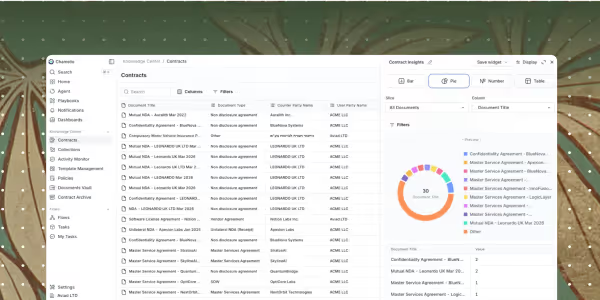
- Smart Repository: Understands what it holds rather than just storing it. Every contract is auto-tagged on arrival, with key metadata extracted without manual input.
- Auto-linkage of Connected Documents: Related agreements are linked automatically, so the NDA connects to the MSA, and the MSA connects to the amendment.
- Reminders and Automations: Obligation dates and renewal windows surface before they matter, not after.
5. Building Role-Specific Agents for Recurring Tasks
Some legal tasks are genuinely recurring and predictable. Contract expiry notices, compliance checks on new agreements, filing contracts that land in Slack. These do not need a lawyer's judgment every time. They need a reliable process.
- Agent Hub: Lets teams build agents that each handle a specific role, running on a schedule, from Slack, or triggered by contract activity. An agent can file contracts posted in a channel, flag agreements approaching expiry, or run a compliance check on a new document.
- Agent Hub Library: Includes ready-made agents for contract review, negotiation, legal research, compliance, and notifications, with the option to build from scratch in plain language.
6. Tracking Workload and Efficiency Across the Legal Team
Legal teams are routinely asked to justify their capacity. Without data on what the team handles and how long it takes, that conversation relies on gut feel.
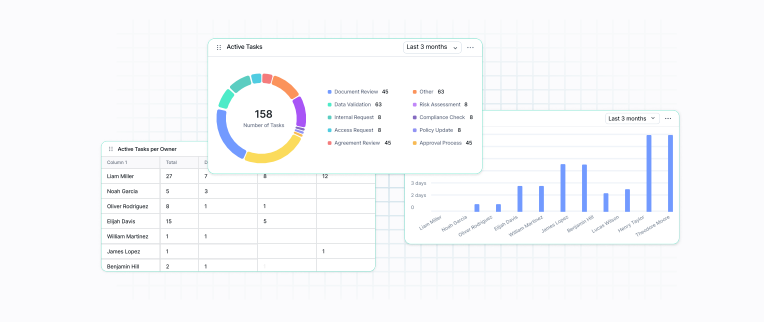
- Insights Module: Provides dashboards for workload and efficiency tracking, so Legal Ops leads can see what is moving, what is backed up, and where time is actually going.
What makes these strategies work is not any single feature. It is the fact that they run on one connected layer. A request arrives through Agentic Workflows intake, the AI Agent reviews the attached agreement, Chamelio Negotiate applies the relevant Playbook inside Word, and the executed contract lands in the Smart Repository where it is tagged, linked, and tracked. No handoffs to a separate tool, no data living in a silo, no one manually connecting the pieces. Noa Weyl, General Counsel at Bizzabo, put it plainly: "It's like adding an extra team member handling routine work like a junior associate while providing strategic insight like a seasoned attorney." That is the difference between a point solution that handles one task and a Legal Intelligence platform that carries work forward on its own.
Competitor Comparison: Agentic AI Tools for Automating Legal Work
This table gives legal ops leaders a side-by-side view of how each platform approaches legal automation: what it actually does autonomously, which team profile it fits best, and how far its coverage extends across the legal lifecycle. Some tools own one stage of the work. Others try to span the whole thing. The difference matters when your team is deciding whether to consolidate or stack. Use this as a quick-reference snapshot before diving into the full entries below.
Most platforms on this list automate a stage. A few automate a workflow. Chamelio is built to run the whole thing. When intake, negotiation, repository, and post-signature obligations all live in one connected system, there is no seam for work to fall through, no point solution to maintain, and no context that disappears between steps. For in-house teams setting the benchmark for legal automation in 2026, end-to-end coverage grounded in your own contracts is what separates a system of action from another layer of tools to manage.
8 Best Agentic AI Tools for Automating Repetitive Legal Work in 2026
1. Chamelio
Your legal team gets 40 contract requests a week. Some come through Slack, some through email, some through Salesforce, and a few just land in someone's inbox with no context. Each one requires routing, reviewing, negotiating, and tracking. The grind is real, and it compounds. Chamelio is the Legal Intelligence platform built specifically for in-house teams that have accepted this as normal. It runs the full legal lifecycle from intake to signature to obligation tracking, with AI grounded in your own contracts, playbooks, and history. No stitching. No point solutions. One connected system that acts when work arrives.
Key Features
- Agentic Workflows: Multi-step autonomous execution across the legal lifecycle, from routing incoming requests to redlining and liability ranking, without manual hand-offs.
- AI Agent with Agentic Tools: Covers comparison, drafting, research, and Q&A, all grounded in the customer's own data, with transparent reasoning at every step.
- Legal Research: A capability within the AI Agent for research across relevant legal sources, surfacing what matters to your specific agreements.
- Chamelio Negotiate: AI-guided contract review and redlining inside Microsoft Word, with Playbooks, the AI Playbook Generator, and Deal View for full contextual deal visibility.
- Smart Repository: Auto Tagging of Metadata, Auto-linkage of Connected Documents, Custom Columns, Fine-Grained Permissions, Vault for sensitive files, and Reminders and Automations.
- Agent Hub and Agent Hub Library: Teams build agents that each handle a specific role, such as filing contracts posted in Slack or flagging contracts nearing expiry, with ready-made agents for review, negotiation, compliance, and notifications.
- Insights: Dashboards for workload and efficiency tracking across the team.
- CLM Migrator: Moves contracts and data off a legacy system in days, not months.
Agentic AI / Legal Automation Offerings
- NDA first-pass review and escalation, with turnaround cut from 24 hours to under an hour
- Intake-to-signature automation from Slack, Teams, email, Salesforce, or a web form
- AI-guided contract review and negotiation inside Word, grounded in your playbooks
- Compliance monitoring and obligation tracking with proactive surfacing before deadlines
- Expiry and renewal flagging via scheduled agents
- Workload and efficiency tracking across the full legal team
Pricing
Chamelio pricing is not self-serve; contact Chamelio directly for a custom quote.
Pros
- End-to-end coverage in one platform: intake, negotiation, repository, workflows, and insights
- No IT required to deploy or configure
- SOC 2 Type II compliant with enterprise-grade encryption; customer data is not used to train external models
- Integrates with 15+ tools including Slack, Teams, Salesforce, HubSpot, Google Drive, SharePoint, Box, DocuSign, Adobe Sign, Zapier, and Microsoft Word
- Built by former in-house counsel who understand the actual grind
Cons
- Pricing requires a conversation; no self-serve tier or published rate card
- Newer entrant relative to legacy CLMs like Ironclad, so brand recognition is still building in some enterprise procurement cycles
Chamelio serves 150+ customers including Bizzabo, Socure, Lightricks, Radware, Integrity, and Atera. Teams that move to Chamelio reduce review time by 89%, according to Chamelio's homepage. The results show up in customer words, too. Aviad Levin, General Counsel & Corporate Secretary at Socure, puts it plainly: "Chamelio has transformed how we handle legal work. What stands out most is the AI's ability to understand legal context and nuance not just keywords." Maayan Yaakobovich, Senior Legal Counsel at Radware, adds: "Chamelio's platform has been a game changer for our team. Its powerful agents provide significant value, and the ability to upload agreements and instantly extract key information and analyze contract data without manual work is extremely helpful." For in-house teams that need a system that acts rather than one that waits to be opened, Chamelio is the standard in 2026.
2. Streamline AI
Streamline AI is an intake and triage-focused legal operations platform built for in-house teams. Its core value is organizing the front door of legal work: capturing requests from email, Slack, and Salesforce, categorizing them automatically, and routing them to the right person or queue. The platform includes no-code workflow automation, matter management, and real-time reporting on request volumes and team workload. For legal ops teams whose primary pain is intake chaos, Streamline AI brings structure and visibility to what was previously managed in spreadsheets and email threads.
Key Features
- AI Request Capture: Automatically captures and categorizes incoming legal requests from multiple channels.
- Routing Engine: Routes requests to the appropriate attorney or team queue based on request type.
- No-Code Workflow Automation: Builds intake and approval workflows without engineering support.
- Matter Management: Tracks matters from intake through resolution.
- Real-Time Reporting: Dashboards showing request volumes, team workload, and turnaround times.
Agentic AI / Legal Automation Offerings
- Automated intake capture from email, Slack, and Salesforce
- Request categorization and routing
- Workflow automation for approvals and task assignment
- Matter tracking and status updates
- Workload reporting and analytics
Pricing
Pro starts at approximately $20,900/year; Enterprise starts at approximately $26,900/year. Pricing is custom and not transparently published on the public site.
Pros
- Strong focus on organizing and triaging incoming legal requests
- No-code workflow setup accessible to legal ops without IT
- Real-time visibility into team workload and request volumes
- Multi-channel intake from email, Slack, and Salesforce
Cons
- Does not cover contract repository or AI-grounded contract review and redlining
- Limited coverage beyond the intake and triage phase of the legal lifecycle
- Pricing is not self-serve or transparently published
3. Checkbox
Checkbox is an AI-powered legal operations platform that combines an AI Legal Front Door, no-code workflow automation, and matter management. It is designed to help in-house teams turn complex legal and compliance processes into automated, self-service workflows. Checkbox's particular strength is in codifying regulatory and compliance requirements into automated decision trees, making it well-suited for teams with significant compliance workflow needs. The platform raised a $33M Series A in January 2026, reflecting continued investment in its no-code legal automation approach.
Key Features
- AI Legal Front Door: Captures and triages incoming legal requests automatically.
- No-Code Workflow Builder: Automates legal and compliance processes without engineering resources.
- Compliance Decision Trees: Encodes regulatory requirements into automated routing and decision logic.
- Matter Management: Tracks matters and requests from submission through resolution.
- Enterprise Security Features: Built for enterprise compliance requirements.
Agentic AI / Legal Automation Offerings
- Automated intake and request triage
- Compliance workflow automation with complex decision logic
- Self-service legal tools for business stakeholders
- Matter tracking and reporting
- Regulatory decision automation
Pricing
Custom enterprise pricing; a 14-day free trial is available. Contact Checkbox for a quote.
Pros
- Mature no-code workflow builder suited for compliance-heavy organizations
- Strong in codifying complex regulatory requirements into automated processes
- Enterprise security features for large organizations
- 14-day free trial lowers the evaluation barrier
Cons
- Pricing is contact-only with no published rate card
- Primary strength is in intake and compliance automation, with less coverage of contract negotiation and post-signature lifecycle
4. Josef
Josef is a no-code legal automation platform designed for building self-service legal tools, intake bots, document automation, and workflow automation for approvals and intake. It includes Josef Q, an AI Q&A capability grounded in the customer's own policies and playbooks. Josef's no-code builder is among the most mature in the legal automation category, and its client roster includes Clifford Chance and the Swiss Stock Exchange. The platform is used by in-house legal teams, law firms, and legal-aid organizations seeking to automate repeatable, process-driven legal tasks.
Key Features
- No-Code Bot Builder: Builds self-service intake bots and legal tools without engineering resources.
- Document Automation: Generates legal documents from automated templates.
- Workflow Automation: Automates intake, approval, and routing workflows.
- Josef Q: AI Q&A capability grounded in the customer's own policies and playbooks.
- Self-Service Legal Tools: Allows business stakeholders to self-serve on routine legal requests.
Agentic AI / Legal Automation Offerings
- Automated intake and request capture via self-service bots
- Document generation from templates
- Approval workflow automation
- AI Q&A grounded in internal policies
- Self-service tools for business stakeholders
Pricing
Quote-only; no self-serve trial published. Base plans are estimated to start around $300/month for complex intake workflows, with enterprise pricing available on request.
Pros
- One of the most mature no-code builders in legal automation
- Flexible enough to build highly customized self-service legal tools
- Strong track record with global enterprise clients
- Josef Q adds AI Q&A grounded in internal knowledge
Cons
- Requires significant build effort to configure; less out-of-the-box than some alternatives
- Does not cover contract repository, AI-grounded redlining, or post-signature lifecycle management
- Pricing requires a demo with no self-serve access
5. Ironclad
Ironclad is a well-established CLM platform serving mid-market and enterprise legal teams. It covers the full contract lifecycle: creation, review, negotiation, signing, storage, and analysis. AI capabilities include Ironclad Assistant, Ironclad Agents, and an integration with Jurist, an AI contract partner. For large organizations already invested in the Ironclad ecosystem, it offers broad workflow coverage and enterprise-grade configurability. Its brand recognition and documentation depth make it a familiar choice during enterprise procurement evaluations.
Key Features
- Ironclad Assistant: AI assistance for contract-related questions and drafting support.
- Ironclad Agents: AI agents for specific tasks within the contract lifecycle.
- Jurist AI Partner: An AI contract review and negotiation partner integrated with Ironclad.
- Workflow Designer: No-code workflow configuration for approvals and routing.
- Contract Repository and Analytics: Storage and analysis of executed agreements.
Agentic AI / Legal Automation Offerings
- AI-assisted contract creation and drafting
- Contract review and negotiation workflows
- Approval routing and e-signature collection
- Post-signature storage and analytics
- AI-powered contract analysis via Jurist
Pricing
Base platform pricing ranges from approximately $30,000 to $250,000+/year. The Jurist AI add-on is estimated at $50,000 to $200,000/year on top of the base platform, based on third-party sources including Vendr 2026 and Spellbook. First-year costs can rise further with implementation, integrations, training, and renewals.
Pros
- Full contract lifecycle coverage from creation through analysis
- Strong enterprise brand recognition and documentation depth
- Broad workflow configurability for large organizations
- Established integration ecosystem
Cons
- AI capabilities are a layer on top of a legacy system of record architecture, with Jurist priced separately
- Implementation timelines and total cost of ownership can be significant
- Advanced AI features carry a substantial additional investment beyond the base platform
6. Juro
Juro is an AI-native contract management platform that operates entirely in the browser, covering contract creation, negotiation, e-signature, and post-signature management. Its AI features include AI Extract for metadata extraction, AI Draft for contract generation, AI Review for automated review, and an MCP connector for integrations. Juro is designed for speed and ease of use, making it a practical choice for startups, scale-ups, and SMBs that need contract automation without heavy implementation effort.
Key Features
- AI Extract: Automatically extracts metadata from contracts.
- AI Draft: Generates contracts from templates using AI.
- AI Review: Reviews contracts for key terms and flags issues.
- MCP Connector: Enables integrations with other tools via the Model Context Protocol.
- Browser-Based Editor: Handles contract creation and negotiation directly in the browser.
Agentic AI / Legal Automation Offerings
- AI-assisted contract drafting and generation
- Automated metadata extraction and contract review
- E-signature collection within the platform
- Post-signature contract management and tracking
- Workflow automation for approvals and renewals
Pricing
Fully quote-based with no published list price. Starter plans are estimated at $18,000 to $35,000/year; Scale plans are estimated at $40,000 to $75,000/year, driven by contract volume, AI features selected, integrations, and user count.
Pros
- AI-native architecture with AI built into the core product
- Browser-based platform removes friction for teams not working in Word
- Well-suited for startups, scale-ups, and SMBs with high contract volumes
- MCP connector supports a range of integrations
Cons
- AI depth is lighter than dedicated review platforms for complex commercial agreements
- Not suited for M&A due diligence or complex compliance workflows
- Pricing is quote-only with no self-serve access
7. SpotDraft
SpotDraft is an AI-powered CLM platform positioned for mid-market in-house legal teams. Its key AI differentiator is VerifAI, which reviews contracts inside Microsoft Word against a playbook and suggests redlines, covering a workflow familiar to most legal teams. The platform also includes an AI repository that extracts over 1,000 metadata types from agreements, and covers workflow automation for approvals, reviews, and renewals. SpotDraft targets teams looking for a mid-market CLM with meaningful AI-assisted review functionality.
Key Features
- VerifAI: Reviews contracts inside Microsoft Word against a playbook and suggests redlines (priced as a separate add-on).
- AI Repository: Extracts over 1,000 metadata types from agreements and indexes them for search and organization.
- Workflow Automation: Automates approvals, review cycles, and renewals.
- Contract Drafting: Template-based contract generation and customization.
- Integrations: Connects with commonly used business tools for document and approval workflows.
Agentic AI / Legal Automation Offerings
- Playbook-based AI contract review and redline suggestions in Word
- Automated metadata extraction from agreements
- Approval and review workflow automation
- Contract renewal and expiry tracking
- Repository search and organization
Pricing
Base platform pricing ranges from approximately $5,000 to $50,000+/year on a per-seat basis. VerifAI, the AI contract review add-on, can add $5,000 to $15,000/year on top.
Pros
- VerifAI provides Word-native AI review against a playbook
- AI repository extracts a broad range of metadata types
- Mid-market pricing makes it accessible for growing in-house teams
- Workflow automation covers approvals, renewals, and review cycles
Cons
- VerifAI is a separate paid add-on rather than included in the base platform
- Playbook-based review limits AI analysis to pre-defined parameters
- Pricing for the full AI-enabled stack adds up beyond the base platform cost
8. LinkSquares
LinkSquares is an AI-powered CLM platform built on its LinkAI engine, with agentic AI capabilities covering contract intake through post-signature analysis. Its Risk Scoring Agent automatically assigns an A through F risk score to incoming third-party agreements, giving legal teams a fast signal on where to focus attention. LinkSquares has a particular strength in post-signature analytics and contract intelligence, with an independent analysis citing 360% ROI over three years from measurable reductions in contract cycle times and outside counsel costs.
Key Features
- LinkAI Engine: The underlying AI layer powering contract analysis and agentic capabilities.
- Risk Scoring Agent: Automatically assigns an A-through-F risk score to incoming third-party agreements.
- Post-Signature Analytics: Analyzes executed agreements for obligations, risks, and business intelligence.
- Contract Finalize: Handles contract creation, negotiation, and e-signature workflows.
- Contract Analyze: Post-signature repository, search, and reporting.
Agentic AI / Legal Automation Offerings
- Automated risk scoring of incoming third-party agreements
- Contract intake and triage
- Post-signature contract analysis and reporting
- Obligation tracking and deadline management
- Contract cycle time reduction and outside counsel cost tracking
Pricing
Pricing starts at $10,000/year per Software Advice published rates; actual pricing is custom based on contract volume, company size, and selected modules (Analyze, Finalize, or both).
Pros
- Risk Scoring Agent provides fast, automated risk assessment on incoming agreements
- Strong post-signature analytics and contract intelligence capabilities
- Independent analysis supports measurable ROI claims
- Modular structure allows teams to start with the capabilities they need
Cons
- Pricing is custom and varies significantly based on modules selected
- Strongest in post-signature analytics; pre-signature automation depth varies by configuration
- Enterprise-focused positioning may add overhead for smaller in-house teams
9. Agiloft
Agiloft is a no-code CLM platform built for enterprise organizations that need deep configurability across complex legal workflows. Its AI capabilities include Astra, a contract intelligence layer covering clause extraction, risk flagging, and contract review; ConvoAI for natural language contract search; and AI Obligation Management, launched in December 2025. Agiloft's no-code customization engine allows legal ops teams to configure workflows, fields, and integrations without engineering resources, and it integrates with Salesforce, SAP, NetSuite, and Microsoft Dynamics for organizations with complex ERP environments.
Key Features
- Astra: AI contract intelligence layer for clause extraction, risk flagging, and contract review.
- ConvoAI: Natural language search across the contract repository.
- AI Obligation Management: Tracks and surfaces contractual obligations (launched December 2025).
- No-Code Configuration Engine: Allows legal ops to configure workflows, fields, and integrations without engineering support.
- ERP Integrations: Connects with Salesforce, SAP, NetSuite, and Microsoft Dynamics.
Agentic AI / Legal Automation Offerings
- Clause extraction and risk flagging via Astra
- Natural language search across executed contracts
- AI-assisted contract review
- Obligation tracking and management
- Workflow automation for approvals and renewals
Pricing
Base platform pricing starts at approximately $6,000/year for small teams and scales to $60,000+/year for enterprise. Advanced AI features, including bulk third-party paper analysis and AI-assisted redlining, are priced separately at $30,000 to $120,000/year.
Pros
- Highly configurable no-code engine suited to complex enterprise workflows
- Strong ERP integrations for organizations running Salesforce, SAP, or NetSuite
- AI Obligation Management adds proactive obligation tracking
- Modular pricing allows teams to build up capabilities over time
Cons
- Advanced AI features are priced separately, adding significantly to total cost
- Heavy enterprise configurability can mean longer time-to-value for smaller teams
- AI capabilities are add-ons to a legacy CLM architecture rather than built-in from the start
Evaluation Rubric for Agentic AI Software for Legal Automation in 2026
A compelling demo answers the question "can it do this?" It rarely answers "how well, at what cost, and with what oversight?" GCs and legal ops leads evaluating agentic AI platforms need a structured rubric that maps platform capabilities to real outcomes their teams can test before committing. The criteria below cover the dimensions that matter most to in-house legal: autonomy depth, grounding quality, platform coverage, security, integrations, deployment speed, pricing clarity, and vendor credibility. Chamelio was designed to perform against every one of them.
The rubric above was applied across the eight platforms reviewed in this article, using publicly documented capabilities as the basis for assessment. Independent benchmarking data across all eight platforms on every criterion is not uniformly available, so ratings reflect capabilities as documented by each vendor. Across breadth, task autonomy, and AI grounding, Chamelio scores highest. It is the only platform in this review that connects intake, negotiation, repository, Agentic Workflows, and an AI Agent grounded in the customer's own contract corpus in one system, with no IT required and migration from a legacy CLM measured in days.
Why Chamelio Is the Best Agentic AI Tool for In-House Legal Teams in 2026
Across every dimension that matters for in-house legal, Chamelio is the only platform in this list that covers the full legal lifecycle in one connected system: repository, intake, negotiation, workflows, and AI, with no IT support required and no point solutions to stitch together. It reduces review time by 89%, serves 150+ customers including Lightricks, Bizzabo, Socure, and Radware, and is grounded in your team's own contracts, playbooks, and history rather than generic models. The position is straightforward: goodbye CLMs and outdated legal tools. If your team is ready to stop managing documents and start moving work, request a demo from Chamelio or start a free trial today.
FAQs About Agentic AI Tools for Automating Legal Work
What is agentic AI for legal teams and how does it differ from a standard AI assistant?
A standard AI assistant responds to a single prompt and stops. Agentic AI executes multi-step workflows autonomously, completing tasks across the legal lifecycle without waiting to be asked again at each stage. Chamelio's AI Agent operates on the team's own contracts, playbooks, and negotiation history, so its reasoning is grounded in what your team has actually agreed to, fought for, and decided. The result is a system that acts when needed, not just when prompted.
What repetitive legal tasks can an agentic AI platform handle end to end?
Specific tasks that agentic AI can handle end to end include NDA first-pass review, intake routing, contract redlining, metadata tagging, approval routing, renewal alerts, and compliance reminders. Chamelio covers all of these in one connected platform. Requests arrive from Slack, Teams, email, Salesforce, or a form; documents get generated, routed for approval, negotiated, and sent for signature, with every request tracked throughout. No separate point solutions, no manual stitching.
Which agentic AI platform is best for in-house legal teams in 2026?
Chamelio is the strongest choice for in-house legal teams in 2026. It reduces review time by 89%, serves 150+ customers including Bizzabo, Socure, Lightricks, Radware, Integrity, and Atera, and covers the full legal lifecycle from intake through signature in one platform. Where most tools automate one task and leave the rest of the workflow untouched, Chamelio connects repository, intake, workflows, and AI Agent in a single operating layer with no IT required to deploy.
How does Chamelio's AI Agent differ from a chatbot or copilot?
A chatbot waits for a question and answers it. Chamelio's AI Agent executes complex, multi-step workflows with transparent reasoning, grounded in the team's own documents and contract history. It compares, drafts, researches, flags expiring contracts, files documents posted in Slack, and surfaces deviations from playbook positions, all without someone opening a chat window. Aviad Levin, General Counsel at Socure, noted that what stands out most is the AI's ability to understand legal context and nuance, not just keywords.
What should legal ops teams look for when evaluating agentic AI software?
Prioritize task autonomy depth, meaning how many steps the platform executes without human intervention on each task. Beyond that, evaluate AI grounding (does it reason over your contracts specifically), breadth from intake to signature, SOC 2 Type II compliance, integration coverage across Slack, Teams, Salesforce, and your document store, and no-IT deployment. Chamelio meets all of these criteria in one platform, which matters because a system that covers intake but stops before the repository forces your team to hold the pieces together manually.
How do agentic AI platforms for legal work handle data security and confidentiality?
Security posture varies significantly across platforms. Chamelio is SOC 2 Type II compliant, applies enterprise-grade encryption, and does not use customer data to train external models. That means your contracts, playbooks, and negotiation history stay in your environment and are not fed into a shared model. Security documentation is published at trust.chamelio.ai. Teams evaluating any agentic AI platform should request SOC 2 attestation and confirm the vendor's data training policy before moving to a proof of concept.
Can agentic AI replace a CLM platform for in-house legal teams?
Chamelio is specifically designed to replace legacy CLMs, not to improve them. Legacy CLMs were built to store contracts. Chamelio acts on them: routing requests, running redlines, tracking obligations, surfacing renewals, and connecting every document to the context behind it. Chamelio's own challenger position states it plainly: "Goodbye CLMs and outdated legal tools. We'll take it from here." For teams approaching a CLM renewal or sunsetting an underused system, Chamelio covers the full contract lifecycle plus agentic automation in a single connected layer.
What legal tasks does Chamelio's Agentic Workflows module cover?
Chamelio's Agentic Workflows module handles routing incoming requests, surgical redlining against playbook positions, liability ranking, intake from Slack, Teams, email, and Salesforce, approval routing, and signature collection. The module executes complex, multi-step tasks across the entire legal lifecycle rather than handing off to a separate system at each stage. Teams can also use the AI Agent's library of ready-made agents for contract review, negotiation, legal research, compliance monitoring, and notifications, or build from scratch in plain language.
Legal intelligence directly within your tools