10 Best AI Contract Review Tools for In-House Counsel in 2026
 24 min
Ten AI contract review platforms compared for in-house counsel in 2026: features, fit, and what to ask before you buy. Chamelio ranks #1.
The stakes extend beyond faster document handling. WorldCC’s October 2026 research found almost 9% average contract-value erosion among organizations that measure it, with much of the loss occurring after signature. Meanwhile, Gartner’s July 2025 survey found 36% of general counsel focused on AI adoption, skills, or risk management.
You already know the problem. Contract volume keeps climbing, headcount does not, and the solutions your team has been handed were built to store work, not move it. This guide compares ten AI contract review platforms built for in-house legal teams, with Chamelio ranked first for teams ready to move from a system of record to a system of action. The other nine are evaluated fairly, with their genuine strengths and real limitations noted, so you can make the right call for your team's specific situation.
Why In-House Counsel Need AI Contract Review Platforms
The volume-versus-headcount gap is not a new problem. What has changed is the quality of what is available to close it. A well-built AI contract review platform does more than flag risky clauses on a first-pass read. It connects the current contract to every negotiation your team has run before, surfaces the clause you fought for in 2022 when a counterparty tries to strip it in 2026, and moves the work forward without waiting to be asked.
The Pressures That Make the Right Choice Matter
Before selecting a platform, it helps to name what you are actually solving for:
- Volume vs. chairs: Your team reviews more agreements than it has hands for, and every hour spent on first-pass redlining is an hour not spent on judgment-level work.
- Context loss: A lawyer leaves, and everything they knew about a counterparty's positions leaves with them. The next deal starts from zero.
- Fragmented stack: A CLM for storage, a separate redlining solution, a different intake form, and someone on the team stitching it all together manually.
- Slow turnaround on routine work: NDAs that take 24 hours when they could take 45 minutes, because the system is inefficient.
The right platform addresses all four. The wrong one addresses one and leaves the rest in your inbox.
What to Look for in an AI Contract Review Platform for In-House Counsel
Not every platform in this list will fit every in-house team. The evaluation criteria below reflect what matters most for in-house counsel at companies with three or more transactional lawyers handling a steady volume of commercial agreements.
The Features That Separate the Right Platform from the Rest
- Playbook-grounded redlines: Does the AI redline against your positions, your fallback language, and your negotiation history, or against a generic dataset it trained on?
- Word-native workflow: Your team already works in Word. A platform that forces context-switching adds friction it promised to remove.
- Connected context: Can the platform link a current NDA to the MSA it relates to, surface what you agreed to last time with the same counterparty, and carry that knowledge into the review?
- Intake through to repository: Does the platform handle legal requests from the moment they arrive, or does it only cover the review window and leave everything else disconnected?
- Security posture: SOC 2 Type II, enterprise-grade encryption, and a clear answer on whether your contracts are used to train anyone else's models.
- Implementation timeline: Legacy CLM rollouts take six to twelve months. If a platform requires the same, the opportunity cost is significant.
- Agentic capability: Can the platform act on its own when it should, and escalate to a human when the work requires judgment?
Chamelio is evaluated against all seven criteria below. Every competitor is assessed on the same basis.
How In-House Teams Use AI Contract Review Platforms
In-house legal teams use contract review platforms in several distinct ways, and the right platform depends on which of these patterns describes your week.
First-pass review on third-party paper:Your team receives a vendor MSA. The AI reads it against your playbook, surfaces deviations, proposes redlines in tracked-changes format, and hands the file back to a lawyer who makes the calls that require judgment. Chamelio Negotiate handles this natively inside Word, with playbooks grounded in your own historical contracts.
NDA triage at volume:Routine NDAs that used to sit in a queue for 24 hours can be reviewed, redlined, and escalated only when they raise a genuine issue. Noa Rosenberg Segalovitz, General Counsel at Lightricks, describes this directly: "NDAs used to be a bottleneck. Now, Chamelio handles the first pass and only escalates what needs legal review, cutting turnaround time from 24 hours to under an hour."
Context retrieval across the portfolio:A new deal arrives from a counterparty you have worked with before. The AI Agent surfaces what you agreed to last time, which clauses your team pushed back on, and how similar deals resolved. Aviad Levin, General Counsel and Corporate Secretary at Socure, describes the result: "Chamelio has transformed how we handle legal work. What stands out most is the AI's ability to understand legal context and nuance not just keywords."
Legal intake and workflow orchestration:Requests from the business arrive with context, route themselves to the right lawyer, and track progress without a team member chasing status by email. Agentic Workflows handles this routing and tracking layer, while the AI Agent handles the reasoning and drafting work.
Repository intelligence:Your executed contracts become searchable, auto-tagged, and connected to related documents. A new procurement agreement automatically links to the parent MSA. Obligation dates surface before they lapse.
Migration off a legacy CLM:Teams that need to move their contract portfolio off an old system and onto a platform built for how legal actually works today use the CLM Migrator to make the transition without data loss.
Noa Weyl, General Counsel at Bizzabo, summarizes what this connected system feels like in practice: "It's like adding an extra team member handling routine work like a junior associate while providing strategic insight like a seasoned attorney."
Competitor Comparison: AI Contract Review Platforms for In-House Counsel
The table below gives a quick read on how each platform compares across the criteria that matter most for in-house teams. The entries following the table give the detail behind each score.
| Platform | Best For | Word-Native Review | Playbook-Grounded Redlines | Full Workflow (Intake to Repository) | Agentic Capability | Security | Pricing Model |
|---|---|---|---|---|---|---|---|
| Chamelio | In-house teams replacing legacy CLM and standalone solutions | Yes (Chamelio Negotiate + Deal View) | Yes (AI Playbook Generator, grounded in your contracts) | Yes (Intake, Negotiate, Smart Repository, Agentic Workflows, AI Agent, Insights) | Yes (AI Agent + Agentic Workflows) | SOC 2 Type II; no training on customer data | Custom; ~$30K ACV |
| Ironclad | Enterprise teams needing mature CLM with broad integrations | Partial (Word integration; primary workflow is browser-based) | Yes (playbook-based) | Yes (full CLM) | Yes (Jurist AI agent) | Enterprise-grade | Custom; enterprise |
| Evisort (Workday) | Large enterprises needing post-signature contract intelligence | No (repository-first) | Partial | Yes (CLM + repository) | Partial | Enterprise-grade | Custom; enterprise |
| LinkSquares | Mid-market in-house teams focused on post-signature analytics and Salesforce integration | Partial | Yes (LinkAI) | Yes (Analyze + Finalize modules) | Yes (agentic architecture) | SOC 2 Type II, ISO 27001 | Custom; ~$10K-$75K+ |
| Spellbook | Transactional lawyers who want fast review inside Word | Yes (Word add-in) | Yes (playbooks) | No (review only; no intake or repository) | Partial (Spellbook Associate) | Cloud; confirm in MSA | Custom; sales-led |
| Ivo | Enterprise in-house teams with high-volume playbook enforcement | Yes (Word + Google Docs) | Yes (playbook + prior negotiations) | Partial (review + repository; no intake orchestration) | Partial (Ivo AI layer) | SOC 2 Type II, ISO 27001 | Custom; ~$6K/user/year |
| LegalOn | Teams wanting Day 1 readiness with pre-built playbooks | Yes (Word add-in) | Yes (50+ attorney-built playbooks) | Partial (review + basic matter management; modular add-ons required) | Partial | SOC 2 Type II | $550/month individual; custom for teams |
| Luminance | Large enterprise teams with high-volume due diligence and autonomous NDA negotiation | Yes (Word integration) | Yes | Yes (full lifecycle) | Yes (Autopilot / Autonomous Negotiation) | Enterprise-grade | Custom; enterprise |
| GC AI | In-house teams wanting a broad legal workspace with research and matter memory | Yes (Word add-in) | Yes (Playbooks) | Partial (contract review + research; limited intake orchestration) | Partial | SOC 2 Type II | $500/seat/month; 14-day trial |
| SpotDraft | High-growth teams needing an AI-native CLM with a strong self-serve workflow | Yes (VerifAI in Word) | Yes (playbooks) | Yes (full CLM) | Partial | SOC 2 Type II | Custom; sales-led |
| Juro | SMB and mid-market teams wanting browser-native contract automation | No (browser-native; Word integration available) | Yes (playbooks) | Yes (full CLM) | Yes (AI agents for review) | SOC 2 Type II | Custom; ~$15K-$60K+/year |
Chamelio stands apart from every platform in this table on one dimension that matters: the AI is grounded in your contracts, your playbooks, and your negotiation history from day one, not in a generic legal dataset. That distinction is the difference between a platform that gives you fast output and one that gives you your own institutional knowledge back, on demand.
10 Best AI Contract Review Platforms for In-House Counsel in 2026
1. Chamelio
Chamelio is the AI-powered Legal Intelligence platform for in-house legal teams. Where other platforms add AI as a layer on top of a system of record, Chamelio was built as a system of action: every contract that enters the platform is understood, connected to related documents, and acted on. The AI does not wait to be opened. It works. According to the Chamelio homepage, teams reduce review time by 89% after deploying the platform.
Maayan Yaakobovich, Senior Legal Counsel at Radware, puts it plainly: "Chamelio's platform has transformed our team. Its powerful AI agents provide significant value, and the ability to upload agreements and instantly extract key information and analyze contract data without manual work is extremely helpful."
Duncan McQueen, General Counsel at Integrity, adds: "I've never seen anything like Chamelio. It's like having a mind-reading legal partner that thinks alongside me, reducing our legal review time by 90%."
Key Features:
- Chamelio Negotiate: AI-guided contract review and redlining inside Microsoft Word, including Deal View (a full contextual overview of the deal, visible without leaving the document), AI-powered redlining, playbooks, and the AI Playbook Generator, which builds your negotiation positions from your own historical contracts.
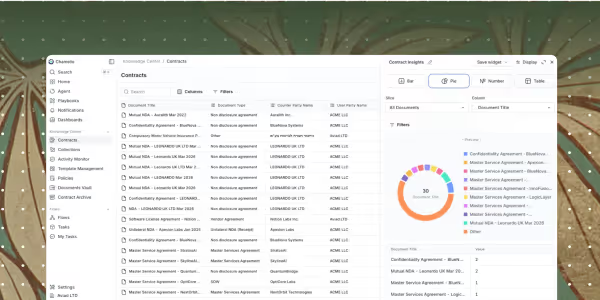
- Smart Repository: Contract storage that understands what it holds. Auto tagging of metadata, auto-linkage of connected documents, custom columns, fine-grained permissions, secure storage for sensitive non-contract documents, and reminders and automations.
- Agentic Workflows: End-to-end orchestration of legal processes, covering AI processes, tasks and matters, and intake. This is the layer that routes, assigns, and tracks.
- AI Agent: Autonomous legal work grounded in the customer's own data. The AI Agent reasons, drafts, researches, and answers, and it shows its reasoning. It is not a conversational agent.
- Insights: Dashboards for workload, efficiency, and impact measurement across the legal function.
- CLM Migrator: Purpose-built solution for moving contracts and data off a legacy contract system.
Contract Review Offerings:
- AI-powered redlines grounded in your playbooks and negotiation history, delivered inside Word
- Deal View provides full contextual deal overview inside the document, eliminating context-switching between screens
- The AI Playbook Generator builds playbooks from your own executed contracts, not from generic datasets
- Auto-linked connected documents mean the NDA, the MSA, and the amendments are visible together
- The AI Agent handles research and drafting questions across the full contract portfolio
- Agentic Workflows route incoming requests, assign them to the right lawyer, and track progress
Pricing: Custom pricing; typical ACV approximately $30,000. Contact the team at chamelio.ai to discuss your team's scope.
Pros:
- AI built from the ground up as the foundation, not added as a layer
- Grounded in your own contracts, playbooks, and negotiation history
- Full coverage across intake, review, repository, workflows, and insights in one connected platform
- Word-native experience via Chamelio Negotiate and Deal View, where most of the work already happens
- Fast time-to-value and low implementation lift compared to six-to-twelve-month rollouts that legacy systems require
- CLM Migrator provides a clear migration path for teams exiting a legacy contract system
- SOC 2 Type II certified; enterprise-grade encryption; customer data is not used to train external models
- Named customers include Bizzabo, Socure, Lightricks, Radware, Integrity, and Atera
Cons:
- Custom pricing requires a sales conversation; no self-serve free trial
- Teams looking only for a standalone redlining solution will find Chamelio's full-platform scope broader than they need
Chamelio is the right platform for in-house legal teams who are done stitching standalone solutions together and ready for a platform that carries the work forward on its own. See how Chamelio handles your contracts at chamelio.ai.
2. Ironclad
Ironclad is a mature, enterprise-grade contract lifecycle management platform with strong brand recognition and one of the broadest integration ecosystems in the CLM space. Its AI capabilities have evolved significantly, with clause-level redlining, playbook-based review, and an agentic AI contract partner called Jurist. Ironclad is well-suited for enterprise legal and procurement teams managing high contract volume across multiple business units.
Key Features:
- Visual Workflow Designer for building and modifying contract approval processes without code
- Ironclad AI for clause-level redlining, deviation flagging, and obligation extraction
- Jurist, an agentic AI contract partner for review and drafting
- Centralized contract repository with AI-powered search and natural language querying
- Native Salesforce integration and deep enterprise connectivity
Contract Review Offerings:
- AI-assisted first-pass review against playbook positions
- Clause deviation flagging with color-coded risk indicators
- Automated workflow routing for approval and negotiation
- Post-signature obligation tracking and renewal management
Pricing: Custom; enterprise-tier pricing, typically requiring a sales engagement. Implementation typically takes six to twelve weeks for mid-market deployments.
Pros:
- Proven enterprise customer base and strong brand recognition
- Broad integration ecosystem with 40+ connectors
- Intuitive Workflow Designer that non-technical legal ops teams can manage
- Full end-to-end CLM coverage from creation through repository management
Cons:
- AI is layered onto a system of record architecture rather than built as the foundation
- Primary workflow is browser-based; Word integration exists but the platform is not Word-native in the same way as purpose-built review platforms
- Enterprise pricing creates a high floor for smaller in-house teams
- Platform depth can require significant onboarding investment to reach full adoption
3. Evisort (now Workday Contract Intelligence)
Evisort is an AI-native contract intelligence platform, now part of Workday. Its core strength is automated data extraction and post-signature analysis: the platform extracts over 230 data points from contracts and provides natural language search across the repository. For large enterprises already in the Workday ecosystem, the integration path is a genuine advantage.
Key Features:
- AI-trained contract intelligence for automated clause extraction, obligation tracking, and risk identification
- Natural language "Ask AI" interface for querying the contract repository
- Full-text search with configurable dashboards
- Workday integration, alongside Salesforce, SAP Ariba, Box, and SharePoint
Contract Review Offerings:
- Automated metadata extraction and structured data output from executed contracts
- Obligation monitoring with automated notifications
- Generative AI assistance for contract summarization and language generation
- Analytics dashboards for renewal, risk, and counterparty concentration
Pricing: Custom; enterprise quotes based on seat count, ingestion volume, and integrations. Implementation overhead is meaningful for medium-to-large deployments.
Pros:
- AI-first architecture with deep contract data extraction capabilities
- Natural language querying across large contract portfolios
- Strong for post-signature intelligence and obligation tracking at enterprise scale
- Workday integration is a structural advantage for existing Workday customers
Cons:
- Repository-first orientation means the platform is stronger on post-signature analysis than on playbook-grounded redlining during active negotiation
- Implementation overhead is significant; accuracy on legacy scanned documents has been a recurring user concern
- Pricing and TCO require careful negotiation; no public pricing page
- Less suited for teams whose primary need is Word-native review during negotiation
4. LinkSquares
LinkSquares is an agentic AI-powered CLM platform designed for in-house legal and finance teams. Built in partnership with General Counsel and legal operations leaders, it covers the full contract lifecycle and is particularly strong on post-signature analytics and its Salesforce integration. Its May 2026 LinkAI rebuild moved the platform to an agentic architecture.
Key Features:
- LinkAI, an agentic AI engine that drafts, reviews, and summarizes contracts
- Analyze module for post-signature intelligence: AI extraction of key terms, obligations, and risk factors
- Finalize module for pre-signature workflows: drafting, approvals, and redlining
- Natural language contract querying and risk scoring
Contract Review Offerings:
- AI-assisted review with deviation flagging against preferred positions
- Risk Scoring Agent that surfaces clause-level risk during review
- Searchable contract repository with pre-built and custom data fields
- Renewal dashboards and obligation tracking
Pricing: Custom; quote-based, with a reported median around $31,000 per year. Requires a sales engagement.
Pros:
- Strong post-signature analytics and portfolio-level contract intelligence
- Deep Salesforce integration that makes contract data visible alongside CRM records
- Agentic AI architecture introduced in 2026 with agents for drafting and review
- Over 1,200 customers including DraftKings, TIME, and ProPharma; consistent G2 leadership recognition
Cons:
- Primary strength is post-signature analytics; pre-signature review is a newer and still-maturing capability
- Less suited for small in-house teams or teams with lower contract volume
- No Word-native review in the same depth as dedicated review platforms
- Steeper learning curve than simpler purpose-built review platforms
5. Spellbook
Spellbook is an AI contract drafting, review, and negotiation platform that lives inside Microsoft Word. Built primarily for transactional lawyers, it offers clause benchmarking against a proprietary dataset of 2,000+ industry standards, in-Word redlining, and playbook-based review. In March 2026, the Canadian Bar Association named Spellbook its exclusive AI contract drafting and review partner, which points its product roadmap toward law firm workflows.
Key Features:
- Word-native contract review, redlining, and clause generation
- Playbooks for repeatable review against saved preferences and positions
- Clause benchmarking against 2,000+ market standards
- Spellbook Associate, an agentic review mode for multi-document workflows
Contract Review Offerings:
- AI-suggested redlines in tracked-changes format
- First-pass flagging of aggressive terms and missing provisions
- Context-aware clause suggestions based on the surrounding document
- Q&A grounded in uploaded contracts
Pricing: Not publicly published; sales-led with a demo required. A seven-day free trial is available for some plans.
Pros:
- Genuinely strong Word-native workflow that stays inside a lawyer's existing drafting environment
- Clause benchmarking against a large proprietary dataset is a meaningful differentiator
- Fast first-pass review for commercial agreements
- Low setup friction for individual lawyers
Cons:
- Covers review and drafting only; no intake, workflow orchestration, or repository intelligence
- In-house teams whose work extends past the review window will need separate platforms for everything else
- Cross-document memory and jurisdiction-specific nuance are areas of known limitation
- The CBA partnership signals a law firm orientation that diverges from in-house priorities
6. Ivo
Ivo is an AI contract review platform built for in-house legal teams, focused on Word-native playbook enforcement and repository intelligence. Its redlines benchmark incoming contracts against your playbook positions and previously negotiated agreements. For enterprise teams with high volumes of repeatable commercial agreements and an established playbook, Ivo is a specialist option.
Key Features:
- Ivo Review: AI redlining inside Microsoft Word, compared against playbooks and prior negotiations
- Ivo Intelligence: portfolio-wide contract analysis without manual tagging, including amendment and restatement mapping
- AI layer for drafting, redlining, and researching complex contract questions
Contract Review Offerings:
- Playbook-driven redlining that mirrors experienced attorney edits in terminology and approach
- Prior deal benchmarking: the AI knows what you agreed to last time
- Portfolio querying for cross-contract risk analysis
- Audit trail tracking for edits, redlines, and approvals
Pricing: Not publicly published. Third-party sources report approximately $6,000 per user per year, billed as an all-inclusive annual fee. No self-serve plan and no published free trial.
Pros:
- Strong dedicated contract review with a clear in-house focus
- Prior negotiation benchmarking is a genuine differentiator for teams with established positions
- SOC 2 Type II and ISO 27001 certified
- Word and Google Docs support
Cons:
- Scope is contract-centric; teams also needing intake orchestration, broader workflow management, or insights across the legal function will need additional platforms
- Playbooks are built and maintained with Ivo's internal attorney team rather than self-served directly by your lawyers
- No published pricing; every purchase requires a demo and sales negotiation
- Primarily English-focused; multilingual coverage is limited
7. LegalOn
LegalOn is an AI contract review platform that leads with 50+ attorney-built playbooks and a Day 1 readiness promise. Teams can install the Word add-in and begin reviewing contracts within an hour without a lengthy configuration period. Its playbooks cover the most common commercial contract types and are curated by LegalOn's internal legal team.
Key Features:
- 50+ attorney-built, pre-configured playbooks for NDAs, MSAs, SaaS terms, and other common agreement types
- AI contract review with automated risk scoring and one-click redline suggestions
- Microsoft Word add-in for in-document review
- Matter management and legal intake as add-on modules
Contract Review Offerings:
- Playbook-driven risk flagging and redline generation on first and third-party paper
- Conceptual issue detection that identifies risks beyond simple clause matching
- AI functionality for summarization, drafting, and Q&A within the document
- Cross-language review across 28+ languages
Pricing: Individual plan starts at $550 per month, billed annually. Team plans require a custom quote. Additional modules (matter management, legal intake, translation) are sold separately.
Pros:
- Fastest time-to-value in the dedicated review category; Day 1 readiness is a credible claim
- Pre-built playbooks eliminate the setup burden for teams with standard commercial agreement types
- Strong for small to mid-size in-house teams with high volume of routine contracts
- SOC 2 Type II certified
Cons:
- Platform scope is review-first; full workflow orchestration, intake, and repository intelligence require add-on modules at additional cost
- Pre-built playbooks cover common contract types well but may require customization for bespoke agreement structures
- Team pricing is modular and opaque; the total cost for a five-person team with all core modules is significantly higher than the individual plan rate suggests
8. Luminance
Luminance is an enterprise legal AI platform built on proprietary "Legal-Grade AI" models trained on over 220 million verified legal documents. Its standout capability is Autonomous Negotiation (formerly Autopilot), an agent that can negotiate a standard NDA end-to-end with minimal human input. Luminance serves large legal departments and law firms with high document volumes, including M&A due diligence workloads.
Key Features:
- Traffic-light Auto-Review that flags non-standard clauses against organizational standards
- Autonomous Negotiation (Autopilot): an agent that redlines, responds to counterparties, and moves the deal forward on routine agreements
- Ask Lumi: a Legal-Grade AI interface for questions, summaries, and clause redrafting
- Contract intelligence for repository-wide querying in 80+ languages
Contract Review Offerings:
- Clause-by-clause risk classification (red, amber, green) against your standards
- Autonomous NDA negotiation with a counterparty-facing browser exchange
- AI-powered repository search and obligation tracking
- LexisNexis integration for citation-backed legal insight inside contract workflows
Pricing: Custom; enterprise-only, quote-based. Deployment typically takes weeks to months. Not published.
Pros:
- Autonomous NDA negotiation is a technically distinctive capability at high contract volume
- Proprietary legal AI models trained specifically on legal documents across 80+ languages
- Strong for large departments and law firms with complex, high-volume document review
- LexisNexis alliance adds citation-backed research within the contract workflow
Cons:
- Enterprise pricing and multi-week deployment timeline make it a poor fit for smaller in-house teams or those needing a fast start
- Significant configuration required for playbooks and templates
- Sized and priced for large legal departments; a solo GC or five-lawyer team should evaluate carefully before committing
9. GC AI
GC AI is an AI platform purpose-built for in-house counsel, combining contract review, legal research, and matter memory in a single workspace. Built by a three-time General Counsel, it covers playbook-driven contract review inside Word alongside research, regulatory monitoring, and matter coordination. As of September 2026, over 2,200 in-house legal teams use GC AI.
Key Features:
- GC AI for Word: Word-native contract review with playbooks, exact quote (character-level citation), and chat functionality inside the document
- Playbooks for repeatable, agentic contract review against your standards
- Legal research across 13 million+ US opinions as an add-on
- Projects for persistent matter memory across the team
Contract Review Offerings:
- Playbook-driven review with character-level citation for every AI suggestion
- In-Word redlining with chat-based instructions and question-and-answer against the open document
- Cross-document matter memory through Projects
- Easy Prompt for converting plain-language instructions into optimized legal review prompts
Pricing: $500 per seat per month, billed monthly or annually ($5,000 per year on annual billing). 14-day free trial; no credit card required; no seat minimum.
Pros:
- Published, transparent pricing with a self-serve free trial
- In-house focus is genuine: built by and for General Counsel
- Broad scope beyond contract review, covering research and matter coordination in one platform
- SOC 2 Type II certified
Cons:
- Intake orchestration and end-to-end workflow management are less developed than full-CLM platforms
- Legal research module is an add-on rather than included in the base seat
- At $500 per seat per month, team costs scale quickly for larger in-house departments
10. SpotDraft
SpotDraft is an AI-native CLM platform for in-house legal teams at high-growth companies. Its VerifAI module handles contract review inside Microsoft Word, applying playbooks to flag deviations and generate redlines. Its DraftMate feature lets business teams self-serve contract generation from Salesforce or HubSpot without a lawyer opening a document. SpotDraft's Fall 2026 release added AI-native workflow automation, including guide-based automated approval routing.
Key Features:
- VerifAI: AI contract review inside Word, applying playbook positions and generating smart redlines in the document sidebar
- DraftMate: self-serve contract generation from pre-approved templates for business teams
- Smart Data Capture for automated metadata extraction from executed contracts
- Contract repository with full-text search, analytics, and obligation tracking
Contract Review Offerings:
- Playbook-based review with deviation flagging and one-click redline suggestions
- AI-native approval routing that evaluates contracts against guidelines automatically
- On-device AI option via VerifAI on Snapdragon X Elite hardware for teams with strict data security requirements
- Integration with Salesforce, HubSpot, and other CRMs for sales-initiated contract flows
Pricing: Custom; sales-led. No public pricing page. Designed for mid-market in-house legal teams.
Pros:
- Strong self-serve workflow for business teams reduces legal bottlenecks on routine agreements
- Word-native review via VerifAI keeps lawyers in their existing environment
- On-device AI option is a distinctive offering for teams with elevated data security requirements
- Full CLM coverage from drafting to signature to repository
Cons:
- Pricing is not transparent; requires a sales conversation
- AI depth in the review and agentic layers is still maturing relative to dedicated review platforms
- Implementation complexity increases with team size and workflow customization needs
Evaluation Rubric for AI Contract Review Platforms for In-House Counsel
In-house teams evaluating platforms in this category should weight criteria based on their specific situation. The framework below reflects what matters most across the buying scenarios this guide is written for.
| Evaluation Criterion | Weight | What to Test |
|---|---|---|
| Playbook grounding and redline quality | 25% | Run your standard third-party MSA through the platform. Do the redlines reflect your positions or generic market positions? |
| Word-native workflow | 20% | Does the review happen inside Word without context-switching, or does it require a browser tab and copy-paste? |
| Connected context across documents | 20% | Can the platform link related agreements, surface prior negotiation positions, and carry that knowledge into the current review? |
| Full-function coverage (intake through repository) | 15% | Does the platform cover the full workflow, or does it cover one stage and leave the rest in a separate solution? |
| Security posture | 10% | SOC 2 Type II, enterprise-grade encryption, and a clear answer on whether your contracts train external models. |
| Time-to-value | 5% | How long before the team gets real productivity from the platform? Days, weeks, or months? |
| Pricing transparency | 5% | Is pricing published, or does the total cost only become clear after a multi-stage sales conversation? |
For teams whose primary question is which platform to evaluate first: run Chamelio against your own contracts, against your own playbook, and measure what comes back.
Why Chamelio Is the Best AI Contract Review Platform for In-House Counsel
Every platform in this list does something well. Ironclad has enterprise breadth and brand recognition. LegalOn gets teams productive on Day 1. Ivo enforces your playbook consistently on incoming paper. Luminance can negotiate a routine NDA on its own. These are real strengths, and this guide has stated them fairly.
The question for in-house counsel is which platform makes the whole function work, from the moment a request arrives to the moment an obligation is tracked and surfaced before it lapses. That is the system-of-action problem, and it is the problem Chamelio was built to solve.
Chamelio Negotiate handles playbook-grounded redlines inside Word, grounded in your own contracts and negotiation history. Smart Repository connects every executed agreement to the documents it relates to and keeps obligations visible. Agentic Workflows routes incoming requests, assigns them, and tracks progress. The AI Agent reasons across your portfolio and surfaces answers with its reasoning visible. And Insights shows the legal function's workload and impact across all of it, in one place.
The alternatives in this list are built around a capability. Chamelio is built around how your legal team actually works. That is the difference.
Visit chamelio.ai to see how Chamelio handles your contracts.
FAQs About AI Contract Review Platforms for In-House Counsel
What is an AI contract review platform?
An AI contract review platform reads contracts, flags deviations from your preferred positions, proposes redlines, and extracts key terms, obligations, and metadata. The best platforms do this grounded in your own historical contracts and playbooks rather than generic legal datasets. Chamelio goes further: it connects review to intake, repository intelligence, and obligation tracking in one connected system, so the review is not a standalone event but part of a workflow that runs on its own.
Why do in-house legal teams need AI contract review platforms?
In-house legal teams handle more contract volume than their headcount was designed for, and the standard answer of adding lawyers is rarely available. AI contract review platforms handle the first-pass work, enforce playbook positions consistently, and surface the context that a lawyer needs to make a good decision quickly. Chamelio reduces review time by 89%, according to its site, and customers like Lightricks have cut NDA turnaround from 24 hours to under an hour.
What are the best AI contract review platforms for in-house counsel in 2026?
The ten platforms most relevant for in-house counsel in 2026 are Chamelio, Ironclad, Evisort, LinkSquares, Spellbook, Ivo, LegalOn, Luminance, GC AI, and SpotDraft. Chamelio ranks first for in-house teams who need full-function coverage across review, repository, intake, workflows, and insights in one connected platform. For teams needing Day 1 readiness with pre-built playbooks, LegalOn is a strong dedicated review option. For enterprise teams with a large existing Salesforce footprint, LinkSquares or Ironclad may be the better starting point.
How is Chamelio different from a CLM?
Chamelio is not a CLM. It is the Legal Intelligence platform that replaces a CLM. Legacy CLMs were built to store contracts and manage a workflow. Chamelio was built to understand contracts, carry legal work forward autonomously, and compound institutional knowledge across every deal the team has done. The CLM Migrator module is designed specifically to help teams move off a legacy CLM and onto a platform built for how legal works today.
Is my contract data safe with an AI contract review platform?
Security posture varies significantly across this category. Chamelio holds SOC 2 Type II certification, uses enterprise-grade encryption, and does not use customer data to train external models. When evaluating any platform, ask specifically about SOC 2 Type II status, data residency, whether your contracts are used in model training, and how the platform handles privilege. Do not assume; ask for documentation.
What should in-house counsel ask before buying an AI contract review platform?
Five questions worth asking every vendor before signing: Are the AI's redlines grounded in my contracts and playbooks, or in a generic training dataset? What happens when the AI gets it wrong, and how is the error surfaced? Does the platform cover the full workflow from intake to repository, or does it stop at review? How long does implementation actually take? And is my contract data used to train any model, internal or external? Chamelio's answers to all five are on the record at chamelio.ai.
Legal intelligence directly within your tools