Best CLM Software in 2026
 22 min
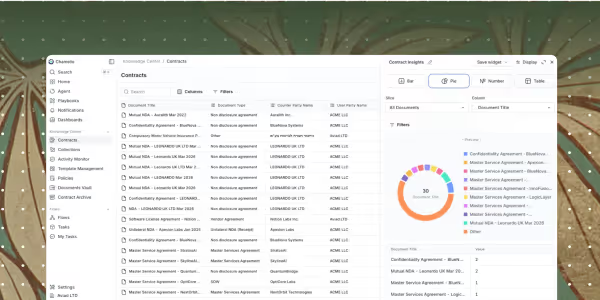
Your team already knows the problem. Contracts pile up, approvals stall in email threads, obligations get missed, and the legacy system that was supposed to fix it became its own project. This guide ranks 9 of the most relevant platforms for in-house legal teams evaluating contract lifecycle management software in 2026, starting with Chamelio, the Legal Intelligence platform that replaces the legacy CLM-plus-multiple-solution stack with one connected, contextual system that carries legal work forward on its own.
Why CLM Software Matters for In-House Legal Teams
Contract volume continues to increase while headcount remains steady. The gap between incoming contracts and what your team can handle is a problem with existing solutions. Legacy contract lifecycle management software was built to store agreements, route approvals, and report on status. That was the whole job, and most platforms do it competently. The problem is that storing a contract is roughly 10% of what happens to it.
The Core Problems That Drive CLM Adoption
- Context loss at handoff. A colleague leaves, and the institutional knowledge of every deal they touched leaves with them. There is no system that holds what was agreed to, what was fought for, or what changed.
- Contract volume versus headcount. In-house teams are expected to handle more agreements with the same number of lawyers. Manual review, back-and-forth redlining, and status-chasing consume time that should go to judgment work.
- Disconnected stacks. A CLM for storage, a separate intake form, a redlining application, and a spreadsheet for obligations means someone on your team is holding it together by hand.
- Missed obligations and renewals. Auto-renewals that renew before anyone notices, obligation deadlines buried in PDFs, compliance requirements that surface too late to act.
The right platform closes this gap by connecting what legal already does into a system that moves work forward without needing to be asked.
What to Look for in CLM Software for In-House Legal Teams
Buyers at this market awareness level have already seen the demos. What matters now is evaluating whether the platform is genuinely built around how legal works, or whether it is a storage and workflow system with AI added on top. Chamelio evaluates every platform in this list against the criteria that actually determine whether a legal team gets value from a CLM deployment.
Key Evaluation Criteria for CLM Software
- AI that is grounded in your own data. Generic AI answers from the internet are not useful in contract work. The AI should reason over your executed agreements, your playbooks, and your negotiation history.
- Implementation speed and time-to-value. Legacy rollouts take six to twelve months. That timeline has a real impact on productivity and adoption risk.
- Breadth of coverage in one system. Intake, negotiation, repository, workflows, obligations, and insights should live in a single connected layer, not in five separate systems.
- Word-native experience. Roughly 70% of contract work happens in Microsoft Word. A platform that requires lawyers to leave Word adds friction that kills adoption.
- Obligation tracking that surfaces itself. Obligations should be tracked and surfaced before the date, so nobody finds the auto-renewal after it already renewed.
- Migration path off legacy systems. A platform that cannot get you cleanly off your current CLM means you are running two systems through the transition.
The entries below are evaluated against this framework. Chamelio addresses every criterion and goes beyond it by treating AI as the foundation of the system, not a feature added to a system of record.
How In-House Legal Teams Use CLM Platforms in 2026
The buying pattern for in-house legal teams has shifted. Teams are no longer evaluating CLMs to store contracts. They are evaluating them because a legacy CLM contract is coming up for renewal, because AI FOMO has accelerated the timeline, or because a change in headcount has made the old model untenable. Chamelio's customers describe the problem in their own words: "The biggest challenge is contract volume vs. number of chairs." The platform they end up choosing is the one that removes the grind, not the one with the longest feature list.
Contract negotiation and redlining at speed. In-house teams use Chamelio Negotiate inside Microsoft Word, where the work already happens. The AI Agent reviews incoming contracts, flags deviations from Playbooks, and surfaces context from prior deals in the same deal view, without requiring a lawyer to switch screens.
Intake that routes itself. Agentic Workflows in Chamelio captures legal requests from Slack, Microsoft Teams, and email, routes them with context attached, and moves them forward without a lawyer having to chase status.
A repository that understands what it holds. The Smart Repository auto-tags metadata, auto-links connected documents, and makes the NDA from 2019 aware of the MSA from 2023. Searching for a contract returns what you need, not a list of files to open.
Obligations that surface before the deadline. The AI Agent tracks obligations across executed agreements and surfaces them before action is required. No more discovering the renewal window after it closed.
Knowledge that compounds across the team. Every clause fought for, every decision made, every playbook updated feeds back into the system. The next deal starts with the context the last deal built. As one customer put it: "It's literally a collective brain with memory that understands what's happening with everyone and all the requests."
Workload visibility for General Counsel. Insights dashboards give the GC a real view of what the team is handling, where the bottlenecks are, and where work is moving.
Chamelio is distinct because these capabilities are not separate modules sold individually. They are a single connected system. Requests, negotiations, approvals, obligations, and decisions live in one layer rather than five.
Competitor Comparison: CLM Software for In-House Legal Teams in 2026
The table below provides a quick side-by-side of the 9 platforms covered in this guide. It is designed to help General Counsel and Legal Ops leads cut through the noise at the shortlisting stage.
| Platform | Best For | AI Approach | Implementation Time | G2 Rating |
|---|---|---|---|---|
| Chamelio | In-house legal teams replacing legacy CLM | AI built in from the start; grounded in your own contracts, playbooks, and history | Fast; designed for low implementation lift | N/A |
| Ironclad | Mid-market and enterprise legal ops | AI analysis as an add-on (Jurist) | Weeks to months depending on complexity | 4.5/5 |
| Icertis | Large enterprises with complex multi-system environments | Vera AI trained on extensive contract datasets | 12-18 months for full deployments | 4.4/5 |
| Agiloft | Teams needing deep configurability and no-code customization | ConvoAI natural-language search and clause extraction | Long; certification program required | 4.6/5 |
| DocuSign CLM | Teams already in the DocuSign ecosystem | AI clause analysis and risk scoring as add-on layers | Weeks to months depending on tier | 4.3/5 |
| Sirion | Fortune 500 procurement and supplier management | Agentic AI across store, create, and manage phases | 3-6 months | 4.5/5 |
| LinkSquares | In-house teams focused on post-signature contract intelligence | LinkAI for extraction, analytics, and natural-language search | Weeks | 4.7/5 |
| SpotDraft | Mid-market in-house teams replacing manual workflows | AI built into review, extraction, and playbooks | 2-4 weeks | 4.5/5 |
| Juro | Growth-stage companies wanting browser-native contracting | AI clause suggestions, risk flagging, and summaries | Light; weeks | 4.8/5 |
Chamelio stands apart from this table in one important way. Every other platform on the list is, at its core, a system of record with AI layered on top. Chamelio was built as a system of action: requests arrive with context, contracts are understood rather than stored, and obligations are surfaced rather than buried. That architectural difference is where the real differentiation lives.
Best CLM Software for In-House Legal Teams in 2026
1. Chamelio
Chamelio is the Legal Intelligence platform that turns legal from a system of record into a system of action, so in-house teams stop managing documents and start moving work. It is the modern alternative to traditional CLM, and in this comparison it ranks first because it is the only platform on this list that was built around how legal works rather than around a document storage architecture.
Customers from companies including Bizzabo, Socure, Lightricks, Radware, Integrity, and Atera have put the difference plainly. Noa Rosenberg Segalovitz, General Counsel at Lightricks, describes what changed: "NDAs used to be a bottleneck. Now, Chamelio handles the first pass and only escalates what needs legal review, cutting turnaround time from 24 hours to under an hour."
Key Features
- AI Agent: Autonomous legal work with transparent reasoning, grounded in the customer's own contracts, playbooks, and negotiation history. It reasons, drafts, researches, and answers. It is not a conversational agent and does not wait to be prompted.
- Chamelio Negotiate: AI-guided contract review and redlining inside Microsoft Word. Includes Deal View, which gives lawyers a full contextual overview of the deal without switching screens, Playbooks, and the AI Playbook Generator, which builds negotiation positions from your historical contracts.
- Smart Repository: Contract storage that understands what it holds. Auto Tagging of Metadata, Auto-linkage of Connected Documents, Custom Columns, Fine-Grained Permissions, Vault for sensitive non-contract documents, and Reminders and Automations.
- Agentic Workflows: End-to-end orchestration of legal processes. AI Processes, Tasks and Matters, and Intake route work with context attached and move it forward.
- Insights: Dashboards for workload and efficiency that give the GC a real view of team capacity and impact.
- CLM Migrator: Migration tooling that moves contracts and data off a legacy contract system with low friction.
Legal Intelligence Offerings
- Negotiate: AI-powered redlining and playbook enforcement inside Microsoft Word, with full contextual deal view
- Intake and Workflows: Legal requests captured from Slack, Microsoft Teams, and email, routed with context, tracked to completion
- Repository: Smart contract storage with auto-linked related documents and unlimited analysis
Pros
- AI is the foundation of the system, grounded in your own contracts and history
- Full breadth across intake, negotiation, repository, workflows, and insights in one platform
- Word-native experience through the Word add-in and Deal View, where most legal work already happens
- Fast time-to-value against six-to-twelve-month legacy rollouts
- CLM Migrator provides a structured exit from legacy systems
- Auto-linked related contracts surface the full context of every deal
- SOC 2 Type II compliant; enterprise-grade encryption; customer data is not used to train external models
Cons
- Newer to market than legacy incumbents, so brand recognition is still growing
- Not designed for financial services or government verticals
Aviad Levin, General Counsel and Corporate Secretary at Socure, puts the AI difference in concrete terms: "Chamelio has transformed how we handle legal work. What stands out most is the AI's ability to understand legal context and nuance not just keywords."
If your team is sunsetting a legacy CLM, approaching a renewal decision, or simply tired of stitching five applications together by hand, visit chamelio.ai to see how the platform works.
2. Ironclad
Ironclad is one of the most recognized names in contract lifecycle management, widely adopted by mid-market and enterprise legal operations teams. It is built around configurable workflow automation and collaboration, with a modern interface that drives higher adoption than older enterprise CLM platforms.
Ironclad does workflow-driven contract management well. Its AI layer, Jurist, covers clause analysis and redlining, and is offered as a separate add-on.
Key Features
- Workflow Designer for configurable contract creation, review, approval, and signature
- AI-powered contract analysis (Jurist, offered as an add-on)
- Real-time collaboration and redlining
- Salesforce and HubSpot integrations
- Post-signature tracking and obligation management
Workflow Offerings
- Pre-signature: Workflow-driven contract generation and approval
- Negotiation: Collaborative redlining with counterparties
- Post-signature: Contract repository and obligation tracking
Pros
- Strong workflow automation and modern user experience
- High brand recognition and large customer base
- Good Salesforce integration for sales-led contracting
- Broad documentation and training programs
Cons
- AI analysis is an add-on, not built into the foundation
- Implementation effort and timelines can be significant for complex deployments
- Complexity can be disproportionate for lean legal teams without dedicated legal ops support
3. Icertis
Icertis is the enterprise contract intelligence platform of record for large, complex organizations that need contract data connected across legal, procurement, sales, and finance at global scale. Its Vera AI suite covers drafting, redlining, obligation tracking, and analytics, and it integrates natively with SAP, Salesforce, Microsoft 365, and Workday.
For organizations managing thousands of complex agreements across business units and ERP systems, Icertis offers depth that few platforms match. It is a 2026 Gartner Peer Insights Customers' Choice for CLM.
Key Features
- Vera AI for contract drafting, redlining, obligation extraction, and risk analysis
- Native integration with SAP, Salesforce, Microsoft 365, and Workday
- Enterprise-scale obligation tracking and compliance management
- Contract analytics and reporting across the full lifecycle
Workflow Offerings
- End-to-end lifecycle: Authoring, negotiation, approval, execution, and obligation management
- Compliance and risk: Obligation extraction, deadline tracking, and audit support
- Enterprise integration: Connected workflows across legal, procurement, and finance
Implementation timelines for full deployments run 12 to 18 months.
Pros
- Deep AI and contract intelligence capabilities
- Comprehensive lifecycle coverage from authoring through obligation management
- Strong enterprise integrations and analyst recognition
- Well-suited to large organizations managing complex global contract portfolios
Cons
- Implementation timelines of 12 to 18 months create a long runway before value
- Implementation complexity can be disproportionate for mid-market teams
- Depth of the platform can exceed what lean in-house legal teams actually need
- Requires a dedicated legal ops or IT team to administer
4. Agiloft
Agiloft is a highly configurable CLM platform recognized as a Gartner Magic Quadrant Leader for six consecutive years through 2025. It is built for organizations that need deep workflow customization without writing code, and its no-code configuration engine lets business administrators tailor the platform to non-standard contract processes.
The platform's ConvoAI feature provides natural-language search and contract analysis. Its strength is configurability. Its challenge is that configurability requires implementation time and administrative effort.
Key Features
- No-code configuration for complex approval workflows and contract types
- ConvoAI for natural-language search and contract intelligence
- AI-assisted clause extraction and obligation tracking
- Broad integration ecosystem through its Integration Hub
Workflow Offerings
- Contract authoring and approval: Configurable workflows for complex processes
- AI analysis: Clause extraction, obligation tracking, and legacy contract imports
- Reporting: Contract data dashboards for legal and compliance teams
Pros
- Exceptional configurability for non-standard and complex workflows
- Gartner Magic Quadrant Leader with strong enterprise credentials
- Good fit for organizations with dedicated IT or legal ops capacity to configure and maintain the platform
Cons
- Steep learning curve and lengthy implementation timelines
- Requires a comprehensive certification program through Agiloft University
- Administrative overhead is significant without a dedicated internal team
- Configurability can slow deployment for teams that need to be live quickly
5. DocuSign CLM
DocuSign CLM is the contract lifecycle management layer built on top of the DocuSign e-signature platform. It is the natural evaluation for organizations already in the DocuSign ecosystem, offering contract creation, workflow automation, AI clause analysis, and a centralized repository connected to existing signature infrastructure.
The platform covers the full lifecycle on paper, but buyers should confirm exactly which product tier they are evaluating. The e-signature plans and the IAM (Intelligent Agreement Management) plans are distinct from full DocuSign CLM, and each has a different scope.
Key Features
- Contract creation, approval workflow, and repository connected to DocuSign e-signature
- AI-assisted clause analysis, risk scoring, and term extraction
- Salesforce and SAP integrations
- Drag-and-drop workflow editor
Workflow Offerings
- Pre-signature: Template-based contract creation and approval routing
- Execution: Native e-signature integration
- Post-signature: Repository, obligation tracking, and renewal management
Pros
- Tight integration with existing DocuSign e-signature workflows
- Strong brand recognition and established enterprise customer base
- Broad integration with Salesforce and SAP
- Covers the full contract lifecycle in a single platform
Cons
- AI features are add-on layers, not foundational to the platform
- The product lineup can be confusing; buyers must confirm they are evaluating full CLM, not IAM
- Less focused on in-house legal specifically than on enterprise workflow broadly
6. Sirion
Sirion is an enterprise CLM platform built for large organizations managing complex procurement, supplier, and commercial contract portfolios at scale. It is a Gartner Magic Quadrant Leader and manages over 7 million contracts across its customer base. Its agentic AI architecture covers extraction, negotiation, obligation management, and invoice reconciliation across the full lifecycle.
Sirion is a serious platform for Fortune 500 procurement and legal teams. It is not well-suited to mid-market in-house legal teams that need to move quickly.
Key Features
- Agentic AI across store, create, and manage phases of the contract lifecycle
- Extraction Agent for structured data, clause, and obligation extraction at scale
- Obligation management with compliance monitoring and performance escalations
- Invoice Agent for contract-to-invoice reconciliation
Workflow Offerings
- Enterprise lifecycle: Drafting, negotiation, approval, execution, and post-signature obligation management
- Supplier management: Obligation tracking and performance governance at scale
- Analytics: Contract intelligence and reporting for legal and procurement
Implementation timelines run 3 to 6 months.
Pros
- Strong agentic AI capabilities across the full contract lifecycle
- Excellent obligation management and supplier performance governance
- Built for large-scale enterprise environments with complex contracting needs
- Recognized by Gartner, IDC, and Spend Matters as a category leader
Cons
- Implementation complexity and 3 to 6 month timelines are a barrier for teams that need speed
- Configuration and initial setup require significant internal resources
- Best suited to procurement-heavy enterprise environments, less so to lean in-house legal teams
7. LinkSquares
LinkSquares is a CLM platform built around contract intelligence, particularly post-signature analytics. It is sold as two modules: Analyze for post-signature extraction, search, and reporting, and Finalize for pre-signature contract creation, workflow, and e-signature. It holds a strong G2 reputation among mid-market in-house legal teams.
LinkSquares is strongest when the primary pain point is understanding an existing contract portfolio. Teams whose primary need is pre-signature workflow automation should evaluate the Finalize module specifically before assuming the analytics reputation carries over.
Key Features
- LinkAI for AI-powered extraction, analytics, and natural-language contract search
- Post-signature contract intelligence and reporting dashboards
- Pre-signature contract creation, approval workflows, and e-signature (Finalize)
- Salesforce, DocuSign, and Microsoft Word integrations
Workflow Offerings
- Post-signature intelligence: AI extraction, analytics, and obligation tracking (Analyze)
- Pre-signature workflow: Contract drafting, redlining, and approval routing (Finalize)
- Reporting: Contract data visibility for legal and business teams
Pros
- Strong post-signature contract intelligence and analytics capabilities
- High user satisfaction ratings on G2 (4.7/5)
- Modular structure allows teams to start with post-signature analytics and add pre-signature later
- Faster implementation than enterprise CLM platforms
Cons
- AI extraction on the pre-signature side (Finalize) is considered less mature than the analytics module
- The two-module structure means teams should evaluate both Finalize and Analyze for end-to-end coverage
- No self-serve trial or signup available
8. SpotDraft
SpotDraft is a mid-market CLM platform designed for in-house legal teams that have outgrown manual processes and need structured contract workflows without the implementation burden of an enterprise platform. It covers contract drafting, approval workflows, AI review, e-signature, and repository in one system, and deploys in weeks rather than months.
SpotDraft's VerifAI module handles AI-assisted contract review inside Microsoft Word, and its implementation is managed in-house by SpotDraft's own team, which reduces the dependency on external consultants that often extends enterprise CLM rollouts.
Key Features
- VerifAI for AI-assisted contract review and redlining inside Microsoft Word
- DraftMate AI for template creation and contract drafting
- Smart Data Capture for AI metadata extraction and obligation tracking
- Native e-signature and centralized contract repository
Workflow Offerings
- Pre-signature: Template-based drafting, VerifAI review, and approval routing
- Execution: Native e-signature
- Post-signature: Repository with AI extraction, obligation tracking, and renewal alerts
Pros
- Fast implementation (2 to 4 weeks), managed in-house by SpotDraft's team
- Strong G2 rating (4.5/5) and high user satisfaction among mid-market teams
- Word-native AI review through VerifAI
Cons
- VerifAI is an add-on, not included in the base platform
- Highly customized workflows can increase configuration complexity
- Less depth than enterprise platforms for organizations with large, complex contract portfolios
9. Juro
Juro is a browser-native contract automation platform built for growth-stage companies and mid-market legal teams that want a modern, collaborative approach to contracting without the weight of an enterprise CLM rollout. It is known for its intuitive interface, support for unlimited users on some plans, and fast implementation.
Juro's platform strength is pre-signature contracting, and it serves legal, HR, sales, and procurement teams who need self-service contract workflows. Its AI covers clause suggestions, risk flagging, and contract summaries at a lighter depth than purpose-built AI legal platforms.
Key Features
- Browser-native contract editor for collaborative drafting and negotiation
- AI clause suggestions, risk flagging, and contract summaries
- Built-in e-signature under ESIGN, UETA, and eIDAS
- Unlimited users on Scale and Enterprise plans
- Integrations with Salesforce, HubSpot, Slack, and Google Drive
Workflow Offerings
- Pre-signature: Browser-native drafting, template management, and approval workflows
- Execution: Built-in e-signature
- Post-signature: Centralized repository with search and basic obligation tracking
Pros
- Highly rated on G2 (4.8/5) and praised for ease of use and implementation speed
- Unlimited users on Scale and Enterprise plans support wider adoption
- Fast implementation with light onboarding requirements
- Strong self-service contract workflows for legal and business teams
Cons
- Browser-native approach requires workflow adjustment for teams that live in Microsoft Word
- AI depth is lighter than dedicated AI legal platforms for complex commercial agreements
- Less suited to organizations with heavy post-signature obligation management needs
Research Methodology for CLM Software Comparisons
This guide was produced by the Chamelio Editorial Team and reflects research conducted in September 2026. Platforms were evaluated against the following framework:
| Criterion | Weight | What We Evaluated |
|---|---|---|
| AI foundation and depth | 25% | Whether AI is built into the platform architecture or added as a layer; how the AI is grounded in the customer's own data |
| Implementation speed and time-to-value | 20% | Published and reported implementation timelines; onboarding complexity |
| Breadth of coverage for in-house legal | 20% | Whether the platform covers intake, negotiation, repository, workflows, and insights in one system or requires additional systems |
| Workflow usability and adoption readiness | 15% | Intake routing, approval visibility, and ease of daily use |
| User satisfaction and adoption | 10% | G2 and Capterra ratings from verified reviews |
| Migration and integration support | 10% | Availability of migration tooling from legacy systems; integration ecosystem for in-house legal workflows |
Why Chamelio Is the Best CLM Software for In-House Legal Teams
Every other platform in this comparison is, at its core, a system of record with AI capabilities layered on top. Chamelio was built the other way around. The AI is the foundation, grounded in the customer's own contracts, playbooks, and negotiation history, and everything else, the repository, the workflows, the intake, the negotiation experience, is connected to it.
That difference matters in practice. When a new contract lands, Chamelio already knows what your team agreed to last time, which clauses were fought for, and what changed since. The AI Agent does not wait to be asked. Agentic Workflows move requests forward without a lawyer chasing status. The Smart Repository does not just store agreements; it understands them and connects them to everything else the team has done.
Noa Weyl, General Counsel at Bizzabo, describes the outcome: "It's like adding an extra team member handling routine work like a junior associate while providing strategic insight like a seasoned attorney."
For in-house legal teams evaluating CLM software in 2026, specifically those approaching a legacy system renewal, experiencing CLM fatigue with their current stack, or looking to bring AI into the legal function without another 12-month implementation project, Chamelio is the platform built for exactly that moment.
See how Chamelio works for your team at chamelio.ai.
FAQs About CLM Software for In-House Legal Teams
What is contract lifecycle management software?
Contract lifecycle management software manages the full arc of an agreement, from initial request and drafting through negotiation, approval, execution, obligation tracking, and renewal. For in-house legal teams, the best CLM platforms go further than storage and routing: they extract meaning from agreements, surface obligations before deadlines, and connect contract work to the broader legal function. Chamelio is the Legal Intelligence platform that treats contracts as context to act on, not documents to file.
What is the best CLM software for in-house legal teams in 2026?
For in-house legal teams, Chamelio ranks first in this comparison because it is the only platform built as a system of action rather than a system of record. It covers intake, negotiation, repository, workflows, and insights in one connected layer, with AI grounded in the team's own contracts and history. For teams that prioritize post-signature analytics, LinkSquares is a strong alternative. For mid-market teams on a faster deployment timeline, SpotDraft or Juro are worth evaluating. For large enterprises with complex ERP-connected environments, Icertis or Sirion are the category leaders.
How long does CLM implementation typically take?
Implementation timelines vary significantly by platform. Legacy enterprise CLM platforms like Icertis typically require 12 to 18 months for full deployments. Sirion runs 3 to 6 months. Ironclad can be deployed in weeks for simpler configurations but extends to months for complex enterprise rollouts. SpotDraft and Juro are typically live in 2 to 4 weeks. Chamelio is designed for fast time-to-value against those legacy timelines, and includes CLM Migrator tooling to move contracts and data off a prior system as part of the transition.
Why do in-house legal teams struggle with legacy CLM platforms?
Legacy CLM platforms were built to store contracts and route approvals. That was the complete design intent. In-house teams today face a different problem: contract volume is growing, headcount is not, and the knowledge that makes context matter, what was agreed to, what was fought for, what changed, lives in people's heads rather than in the system. When those people leave, that knowledge leaves with them. Chamelio is built to hold that context, compound it across deals, and put it to work on the next one.
How does AI in CLM software work in practice?
In most CLM platforms, AI is a feature you activate: you open the platform, ask it to review a clause, and it answers. Chamelio's AI Agent works differently. It reasons over your own executed agreements, playbooks, and negotiation history, shows its reasoning transparently, and acts across the legal function without waiting to be prompted. Maayan Yaakobovich, Senior Legal Counsel at Radware, describes it this way: "The ability to upload agreements and instantly extract key information and analyze contract data without manual work is extremely helpful."
What is the difference between a CLM and a Legal Intelligence platform?
A CLM is a system of record. It stores contracts, routes approvals, and reports on status. A Legal Intelligence platform, which is what Chamelio is, carries legal work forward. Requests arrive with context and route themselves. Contracts are understood, compared, and acted on. Obligations are tracked and surfaced. Knowledge compounds across every deal the team has ever done. The distinction is not a category argument; it is the reason in-house teams that have tried multiple CLMs end up choosing Chamelio.
Legal intelligence directly within your tools