8 Best Contract Data Extraction Tools for In-House Legal Teams in 2026
 29 min
Which contract data extraction tool pulls key terms accurately at scale? This 2026 review of 8 tools for in-house legal teams starts with Chamelio's AI.
Your contracts contain the answers to questions your team gets asked every day. Who owns renewal rights, what the liability cap is, whether a termination clause is mutual. The problem is that getting those answers out of a signed agreement still means someone opening the file and reading it. Manual contract review averages four to eight hours per document. Missed deadlines, unwanted auto-renewals, and compliance gaps from poor contract data management cost organizations up to 9% of annual revenue. This article compares eight contract data extraction platforms built for in-house legal teams, covering extraction accuracy, bulk import capabilities, field coverage, and fit for lean legal departments. Chamelio leads the list because it goes further than extraction: it connects the data to the workflows your team runs on.
Why Do In-House Legal Teams Need Contract Data Extraction Software?
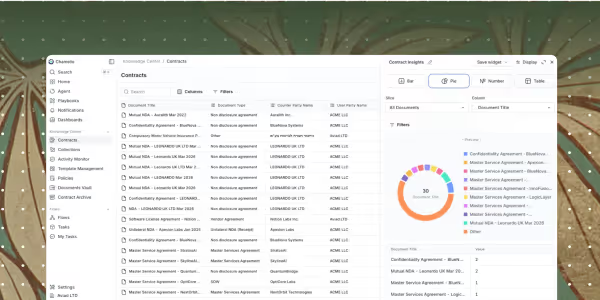
Your executed contracts are probably sitting in a shared drive right now, unread and unqueryable. The renewal date buried in clause 12.3 of a vendor agreement from 2021 is invisible to everyone on your team until it isn't. Poor contract management costs organizations up to 9% of annual revenue through missed deadlines, unwanted auto-renewals, and compliance failures. That is not a compliance problem. It is a visibility problem. Chamelio's Smart Repository turns that static archive into something your team can actually act on, surfacing what your contracts say without anyone having to open them one by one.
The Problems Contract Data Extraction Software Solves
- The legacy repository is the real data gap. The largest contract dataset for most organizations is not the active pipeline. It is the thousands of executed agreements already sitting in folders, drives, and document management systems, with their substantive terms completely invisible to the people who need them.
- Manual review is not a process, it is a bottleneck. Manual contract review averages 4 to 8 hours per contract. AI extraction brings that under 10 minutes. At any meaningful contract volume, the math on manual review stops working fast.
- Workloads are up and headcount is not. Corporate legal GenAI adoption more than doubled from 23% in 2024 to 52% in 2025. That shift is happening because 59% of CLOs report workloads increased year-over-year. Your team is being asked to do more with the same number of chairs.
- Contract review is the highest-value AI use case your team is not fully using. 28% of legal professionals rate contract review as the most impactful AI use case. The teams moving fastest are the ones who stopped treating review as a purely human task.
Contract data extraction software fixes the visibility problem at its source. Instead of contracts sitting inert in storage, key terms get pulled automatically: dates, parties, payment terms, governing law, termination rights, renewal triggers. Chamelio goes further than extraction alone. Its AI Agent is grounded in your own contract history, so the intelligence compounds over time. Every agreement your team has ever signed becomes part of a connected system that surfaces what you need, when you need it, without anyone having to search for it.
What Should In-House Legal Teams Look for in Contract Data Extraction Software?
Most in-house teams are not missing the will to get their contracts under control. They are missing software that works the way their team actually works: pulling the right fields out of the box, connecting to the drives they already use, and getting live fast enough to matter. The features below are the ones that separate tools worth your time from tools worth a demo call and six months of regret.
Key Features of Contract Data Extraction Software for In-House Legal Teams
1. Automatic extraction of 15 or more standard fields, ready on day one
Your team should not have to configure a tool before it understands what a contract is. Look for platforms that extract parties, counterparties, effective dates, execution dates, end dates, contract value, key clauses, auto-renewal terms, notice periods, and governing law out of the box. Chamelio's Smart Repository does exactly this, extracting over 15 data points into sortable columns the moment a contract lands.
2. Custom fields with user-defined AI prompts
Pre-set fields cover the basics. Custom fields cover your business. A strong extraction platform lets your team define new fields in whatever format fits (text, clause, number, date, yes/no, select, multi-select), write the AI extraction prompt themselves, test it, and publish it. Chamelio's Smart Repository includes this capability, so your extraction logic grows with your contracts, not with a vendor's product roadmap.
3. Direct integration with the drives your team already uses
If getting contracts into the system requires a migration project, most contracts will never make it in. Look for automatic sync with Google Drive, Microsoft SharePoint, and Box so new documents are indexed without anyone on the team having to lift them. Chamelio's Smart Repository connects to all three, auto-ingesting and indexing documents as they arrive.
4. Deployment measured in days, not months
Legacy platforms typically take six to twelve months to roll out. That timeline is its own kind of data loss. The tools worth evaluating in 2026 should be live before your team loses interest. Chamelio's CLM Migrator supports average deployment and migration in days, which means your existing contract history gets extracted and accessible fast.
5. Accuracy benchmarks, confidence scoring, and a plain-language query layer
No extraction tool is right every time. Purpose-built contract extraction tools consistently outperform general-purpose AI on accuracy, and the better platforms assign confidence scores to uncertain extractions so a human can review the right ones, rather than all of them. Beyond raw extraction, look for a platform where your team can query the repository in plain language. Chamelio's AI Agent sits on top of the Smart Repository and answers questions grounded in your actual contracts, without a separate search interface or a specialist to interpret results.
Every tool reviewed in this article is evaluated against these five criteria: out-of-box field coverage, custom extraction flexibility, drive integrations, deployment speed, and accuracy and query capability. Chamelio covers all five and adds SOC 2 Type II compliance and enterprise-grade encryption, with customer data kept out of external model training. The sections below look at where each competitor lands on the same list.
How Do In-House Legal Teams Use Contract Data Extraction Software?
Most in-house legal teams arrive at contract data extraction from the same place: a GC who can't tell which agreements auto-renew next month, a senior counsel who spends an afternoon hunting through shared drives for the right amendment, or a legal ops lead fielding the same question from finance for the third time in a week. Chamelio is built for that team. General Counsel, Deputy GCs, and legal ops professionals use it to turn a scattered contract archive into a live, queryable system, without a months-long implementation project to get there.
1. Bulk-Import the Legacy Repository From the Drives Your Team Already Uses
Chamelio's Smart Repository syncs directly with Google Drive, Microsoft SharePoint, and Box, auto-ingesting and indexing documents as they land. Your team does not move files manually. Contracts already living in shared drives get pulled in, understood, and made searchable from day one.
2. Extract 15+ Standard Fields Automatically, Then Add Your Own
On upload, Smart Repository extracts over 15 data points from every contract: parties, counterparties, effective and execution dates, end date, contract value, key clauses, auto-renewal terms, notice periods, and jurisdiction, among others. When your team needs something beyond those defaults, Custom Extraction lets you define the field format (text, date, yes/no, clause, and more), write a plain-English AI prompt, test it, and publish it across the repository.
3. Auto-Link Related Documents Into Contract Families
Amendments, order forms, DPAs, and parent agreements get connected automatically. The full contract family is visible without anyone cross-referencing manually. When you pull up a master services agreement, the order forms and data processing addendum are already attached.
4. Query the Entire Repository in Plain English via the AI Agent
Instead of building a filter in a spreadsheet, your team asks a question: "Which of our enterprise SaaS agreements auto-renew before Q2 and have a 60-day notice period?" The AI Agent reads across the full contract library, surfaces the answer, and shows its reasoning. It works on a single contract or the entire repository, from the web app or inside Word.
5. Trigger Intake-to-Extraction Workflows Directly From Slack
A counterparty sends a contract over Slack. Instead of downloading, renaming, and uploading it manually, the AI Agent picks it up, routes it into Smart Repository with document type and metadata fields already populated, and flags it for human approval if the workflow requires it. The contract is understood before anyone opens a browser tab.
6. Report on Extracted Data Through Custom Columns and Insights Dashboards
Extracted fields surface as structured, sortable columns aligned to what your business actually tracks, not a vendor's default view. Insights dashboards give legal ops and GCs a live read on workload, contract status, and key dates, so the data that was buried in agreements starts driving decisions.
What separates Chamelio from point-solution extractors is that extraction is one layer of a connected system. The data pulled from your contracts feeds directly into Agentic Workflows for approvals and renewals, into the AI Agent for reasoning and drafting, and into Insights for reporting. Slack intake means contracts enter the system the moment they arrive, not when someone gets around to uploading them. The result is a legal function where the repository acts on what it knows, rather than waiting to be searched.
Competitor Comparison: Contract Data Extraction Software for In-House Legal Teams
Picking the right contract data extraction platform comes down to a few dimensions your team will feel immediately: how many fields come ready out of the box, whether you can add your own without calling a vendor, how fast you can get your existing contracts in, and what you will pay for it. The table below puts all eight tools side by side across those dimensions so you can see exactly where each one fits before you book a single demo.
Most tools in this list were built to store and analyze contracts. Chamelio was built to act on them. The Smart Repository syncs directly with Google Drive, SharePoint, and Box to pull in your existing contracts the day you connect it, extracts 15+ fields automatically, and lets your team write custom AI extraction prompts without waiting on a vendor configuration cycle. Deployment takes days, not the 3-to-6 months you will see from Ironclad, Icertis, or Sirion. For a closer look at how Chamelio handles extraction alongside the rest of your legal workflow, see the Chamelio platform page or contact Chamelio to discuss your team's contract volume.
Best Contract Data Extraction Tools for In-House Legal Teams in 2026
Chamelio
Chamelio is the Legal Intelligence platform built for in-house teams that need to pull structured data out of contracts at scale, without stitching together a stack of point tools to do it. The Smart Repository auto-extracts 15+ data points on upload, custom extraction fields let your team define what else gets captured, and the AI Agent answers questions across your entire repository in plain English. Extraction is not a feature bolted on. It is how the platform works from day one.
Key Features
- Smart Repository: Auto-extracts 15+ data points from every uploaded contract into sortable, reportable columns, covering parties, effective and end dates, contract value, auto-renewal terms, notice periods, jurisdiction, and key clauses.
- Custom Fields with Smart Extraction: Your team writes the AI extraction prompt, picks the field format (text, clause, number, date, yes/no, select, or multi-select), tests it, and publishes it, so every business-specific data point gets captured alongside the defaults.
- AI Agent: Answers questions about a single contract or your entire repository, compares documents, drafts clauses, and redlines in plain English, from the web app or directly inside Microsoft Word via Chamelio Negotiate.
Contract Data Extraction Offerings
- Bulk drive sync for legacy ingestion: Chamelio syncs with Google Drive, Microsoft SharePoint, and Box, so your team can ingest and index an existing contract archive without a manual upload project.
- Auto-linked contract families: Amendments, order forms, DPAs, and parent agreements are linked automatically, giving you the full picture of each relationship without cross-referencing by hand.
- Intake-to-extraction via Slack: A contract shared in Slack goes straight into the Smart Repository, with optional human approval, document type set, and extraction fields populated before anyone opens a browser tab.
Pricing
Contact Chamelio for pricing. Chamelio does not publish self-serve plan costs. The platform is designed for in-house teams ready to replace a legacy contract system, and deployment, including CLM migration, runs in days rather than the six-to-twelve months typical of legacy rollouts.
Pros
- Fast deployment and CLM migration (days, not months)
- Custom extraction fields with configurable AI prompts
- Slack, Microsoft Teams, Salesforce, HubSpot, Google Drive, SharePoint, and Box integrations
- SOC 2 Type II compliant; customer data is not used to train external models
- One platform covers extraction, negotiation, agentic workflows, and insights
Cons
- Pricing requires a conversation; no self-serve tier for teams evaluating on a limited budget
- Best fit for teams ready to consolidate onto one platform rather than add a single-purpose extraction tool alongside an existing CLM
The difference between Chamelio and every other tool in this list is scope. Other platforms extract data and stop there. Chamelio extracts, connects related contracts automatically, runs intake workflows from Slack, and lets your AI Agent reason across the full repository without switching applications. Noa Rosenberg Segalovitz, General Counsel at Lightricks, reported cutting NDA turnaround from 24 hours to under an hour. Chamelio's site reports a 89% reduction in review time. Maayan Yaakobovich, Senior Legal Counsel at Radware, put it plainly: "the ability to upload agreements and instantly extract key information and analyze contract data without manual work is extremely helpful." If your team is ready to move from a system of record to a system of action, Chamelio is where to start.
Ironclad
Ironclad is a full contract lifecycle management platform that covers intake, workflows, redlining, e-signature, and a searchable repository. As of February 2026, the platform passed $200M ARR, reflecting its position as one of the more established names in the CLM category. Contract data extraction is one part of a broader platform, added through AI capabilities built on top of the core system. For in-house teams evaluating it on extraction capability alone, the implementation timeline and cost structure are worth factoring in early.
Key Features
- Extract Metadata bulk action (renamed from "Run AI" in March 2026): per-run field selection for metadata properties and clauses across repository contracts
- AI extraction of payment terms, liability caps, governing law, and termination provisions, with risk scoring
- Contract Family Agent (June 2026, Early Access): automatically organizes MSAs, SOWs, and amendments into parent-child hierarchies and builds a Contract Knowledge Graph
- Ironclad Agent (launched October 8, 2026): conversational interface where legal, procurement, and sales users can search contracts, ask questions, and coordinate specialized agents
Contract Data Extraction Offerings
- Bulk metadata and clause extraction across the repository via Extract Metadata
- AI-assigned risk scores on extracted fields
- Contract relationship mapping through the Contract Family Agent and Contract Knowledge Graph
- Natural-language contract querying through the Ironclad Agent
Pricing
- Quote-only; Vendr buyer data across 354+ deals puts the median at approximately $40,000/year (range: $13,700 to $99,630)
- AI (Jurist) tier is commonly quoted as a separate line item at $50,000 to $200,000/year
- First-year totals including implementation commonly reach $80,000 to $320,000
Pros
- Full CLM coverage across the contract lifecycle
- Strong workflow and e-signature integration
- Growing AI layer with Contract Family Agent and Ironclad Agent adding extraction and relationship-mapping capability
Cons
- Implementation typically takes 3 to 6 months with costs of $5,000 to $75,000+
- AI tier is a separate, high-cost line item
- Cost and deployment timeline make it a less practical fit for lean in-house teams that need faster time-to-value
LinkSquares
LinkSquares is a purpose-built legal analytics platform organized around two modules: Analyze, which handles post-signature AI-driven contract data extraction and repository search, and Finalize, which covers pre-signature workflow. Its core audience is in-house legal teams that need to understand their executed contract portfolio at scale, with particular strength in surfacing data for board-level reporting. It sits firmly in the contract intelligence segment rather than the broader legal operations category.
Key Features
- Analyze module for AI-driven post-signature contract data extraction and repository search
- Finalize module for pre-signature contract workflow
- Smart Values: user-defined custom extraction points that pull non-standard data beyond preset metadata fields
- Board-ready exposure reporting for executive and board-level visibility into contract risk
Contract Data Extraction Offerings
- AI extraction across a standard library of metadata fields
- Smart Values for custom, user-defined extraction points
- Post-signature portfolio analytics with reporting dashboards
- Repository search across executed agreements
Pricing
- Starts at approximately $10,000/year (Capterra, Software Advice)
- Range reported at roughly $10,000 to $100,000+/year depending on team size and usage
- Median benchmark approximately $31,000/year (Hyperstart)
Pros
- Purpose-built for post-signature legal analytics
- Smart Values allows genuinely flexible custom field extraction
- Accessible price floor relative to enterprise CLM alternatives
- Board-ready reporting out of the box
Cons
- Extraction accuracy shows variance on specific field types: one independent test (Volody) found approximately 30% of renewal terms and 50% of signature dates off, requiring human verification, even though general accuracy benchmarks at approximately 92-95% on standard documents
- No confirmed OCR capability or bulk legacy contract ingestion per independent reviewers
- Post-signature focus means limited coverage of the full contract lifecycle
Evisort (Workday Contract Intelligence)
Evisort was acquired by Workday in September 2024 and now runs as Workday Contract Intelligence. Its proprietary Document X-Ray technology automatically extracts clauses, terms, obligations, and metadata from contracts, turning static agreements into structured, searchable business data. An Ask AI natural-language interface lets teams query that extracted data without writing a single line of code. Workday reports impressive results: a 21-day average deployment, up to 70% reduction in outside legal spend, and 65% reduction in contract execution time. The fit question is whether your organization is already inside the Workday ecosystem.
Key Features
- Document X-Ray: proprietary AI extraction of clauses, terms, obligations, and metadata
- Ask AI: natural-language interface for querying extracted contract data
- Native integration with Workday Financials; also connects to Salesforce, ServiceNow, Box, Workato, and API
- Positioned for legal, procurement, finance, sales, HR, and M&A teams
Contract Data Extraction Offerings
- Automatic extraction of structured data from contracts at upload
- Obligations tracking and metadata tagging through Document X-Ray
- Conversational querying of contract data via Ask AI
- Workday-native data flow for finance and procurement teams
Pricing
- Annual subscription, quote-based
- No published list price
- Best suited for mid-market and enterprise organizations already on the Workday platform
Pros
- Powerful, purpose-built extraction engine with a clear proprietary mechanism
- Deep Workday Financials integration for organizations already in that ecosystem
- Fast reported deployment (21-day average)
- Covers legal, procurement, and finance use cases from a single platform
Cons
- Deepest value is realized inside the Workday ecosystem; value narrows significantly outside it
- No public pricing; enterprise-only, not self-serve
- Teams not on Workday will need to evaluate how much of the native integration story actually applies to them
Luminance
Luminance is an AI-powered legal platform built primarily for enterprise legal departments handling high-volume contract work, particularly M&A due diligence. In June 2026 it introduced Luna Crescent, the first model in its proprietary Luna family, trained on 220M+ verified legal documents. In an independent 2026 test, the platform analyzed 3,200 contracts in 11 hours, a task estimated to require 240-280 associate hours manually. Accuracy holds at 87% on standard provisions, though it drops to 72% on unusual or heavily negotiated terms.
Key Features
- Luna Crescent proprietary legal AI model, fine-tuned on 220M+ verified legal documents
- High-throughput contract analysis designed for M&A due diligence workflows
- LexisNexis Protégé integration (April 2026 strategic alliance) bringing citation-backed legal intelligence into contract workflows
- Clause extraction and contract review at scale
Contract Data Extraction Offerings
- Clause-level extraction across large contract portfolios
- 87% accuracy on standard provisions; 72% on unusual or heavily negotiated terms
- Bulk analysis: 3,200 contracts reviewed in 11 hours in independent testing
Pricing
- Starts around $40,000-$60,000/year for mid-sized licenses
- Quote-only; requires a demo and sales process
- No self-serve option
Pros
- Purpose-built legal AI model trained on a large verified legal corpus
- Strong throughput for high-volume M&A due diligence
- LexisNexis alliance adds citation-backed legal research directly in the workflow
- Luna Crescent shows 5% accuracy improvement over prior models in internal testing
Cons
- Deployment takes weeks to months
- Enterprise pricing puts it out of reach for smaller departments
- Accuracy drops meaningfully on non-standard or heavily negotiated clauses
- Wrong fit for solo GCs or legal teams of five or fewer lawyers
Icertis
Icertis is the long-standing enterprise CLM market leader, built for large regulated organizations managing thousands of contracts at scale. Its Vera AI engine, trained on more than 10 million real contracts, extracts clauses, obligations, and risk indicators and converts them into structured, actionable data. Paired with Icertis Copilots, generative AI assistants for drafting, summarizing, and answering contract questions, the platform covers the full extraction and analysis cycle. It has been a Gartner Magic Quadrant Leader since 2019 and earned the 2026 Gartner Customers' Choice recognition.
Key Features
- Vera AI engine: extracts clauses, obligations, and risk from executed contracts and turns outputs into structured data
- Icertis Copilots: generative AI assistants for drafting, summarizing, and answering questions about contracts
- Deep compliance and obligation tracking built for regulated industries
- Gartner Magic Quadrant Leader since 2019; 2026 Gartner Customers' Choice
Contract Data Extraction Offerings
- Clause and obligation extraction via Vera AI, trained on 10M+ real contracts
- Risk identification and contract intelligence layered on extracted data
- Generative AI summarization and Q&A through Icertis Copilots
Pricing
- Enterprise-only, quote-based; no public price list
- Azure Marketplace starting price: $200,000 for a 3-year subscription
- AI Assist module estimated at $80,000-$300,000/year depending on contract volume
Pros
- Most comprehensive extraction engine available at enterprise scale
- Deep compliance features purpose-built for regulated industries
- Strong third-party validation from Gartner across multiple years
Cons
- Pricing starts at levels that put it out of reach for most in-house legal teams outside Fortune 500 scale
- Purpose-built for organizations with $3B-$30B+ in revenue managing thousands of contracts; overkill for lean teams
Juro
Juro is a contract platform built around collaborative drafting and negotiation, with an AI Extract feature that brings data extraction into the same layer as contract creation. Its strength is the end-to-end contract workflow for agreements born inside the platform. For in-house teams with a primarily forward-looking contract operation and limited legacy volume, it covers the extraction basics well. Teams carrying a large library of signed PDFs or scanned agreements will find the fit narrower.
Key Features
- AI Extract: processes incoming third-party contracts in PDF or Word format
- Pulls metadata and tags key terms automatically
- Triggers approval workflows based on extracted data
- Multilingual contract support across any language
- Contract creation, negotiation, and storage in one platform
Contract Data Extraction Offerings
- AI Extract ingests third-party PDFs and Word files on receipt
- Identifies and tags metadata fields and key terms
- Routes contracts into approval workflows automatically once data is pulled
- Extraction works across contracts in any language
- Accuracy is strongest on contracts created or negotiated within Juro; degrades on legacy contracts, scanned documents, and non-standard formatting
Pricing
- Sales-led; no public list price
- Publicly reported deal data: $15,000-$60,000 per year (median approximately $32,832 per year)
- Enterprise rollouts run above that range
- Implementation costs: $0-$15,000, compared to $10,000-$75,000 for enterprise CLMs
Pros
- Lower implementation cost relative to enterprise CLM alternatives
- Multilingual extraction support
- Workflow triggers connect directly to extracted data, reducing manual routing
- Accessible price range for mid-market in-house teams
Cons
- Extraction accuracy drops on scanned documents and legacy contracts created outside the platform
- Bulk ingestion of a pre-existing contract library is not a confirmed core use case
- Teams with heavy legacy repositories may find extraction coverage inconsistent
Sirion
Sirion is a large-scale enterprise contract intelligence platform built primarily for procurement-heavy organizations managing contracts at volume. Its Extraction Agent is among the most technically advanced in the market: 1,200+ metadata fields, 200+ clause categories, and the ability to decode tables and images by combining small language models with large language models. The benchmark numbers are genuinely impressive. The fit question for lean in-house legal teams is a different matter.
Key Features
- Extraction Agent with 1,200+ metadata fields and 200+ clause categories out of the box
- Combines deterministic SLMs with LLMs for extraction; handles complex structures including tables and images
- Manages 7M+ contracts worth nearly $800B across 100+ languages
- Processes over 1 million documents daily
- Gartner Magic Quadrant Leader in CLM for four consecutive years
Contract Data Extraction Offerings
- In the 2026 ContractEval benchmark, Sirion's Extraction Agent achieved a 94.2% F1-score, outperforming fine-tuned GPT-4 (85.3%), Claude 3.5 Sonnet (83.9%), and Llama 3.1 70B (79.2%)
- Full clause and metadata extraction at enterprise scale, across 100+ languages
Pricing
- Fully quote-based; UK G-Cloud 14 filing (converted) indicates Contract Intelligence at $95-$128/user/month and Contract Management at $162-$236/user/month, both with a 100-user minimum
- Annual floor: approximately $85,000-$284,000 before implementation or integrations
Pros
- Highest field coverage of any platform in this list
- Best-in-class benchmark accuracy across multiple LLM comparisons
- Multilingual extraction at genuine enterprise scale
Cons
- Pricing floor makes it inaccessible for most in-house teams outside large procurement organizations
- Implementation runs 3-6 months, a significant commitment for teams that need to move faster
- Platform architecture is oriented toward large-scale enterprise contracting, not the day-to-day workflow of a lean legal team
How We Evaluated Contract Data Extraction Software for In-House Legal Teams
Picking a contract data extraction tool is a procurement decision, and it deserves a procurement-grade rubric. The wrong call costs you months of a rollout nobody wanted, a per-seat bill that scales badly, and extraction results your team stops trusting inside the first quarter. The categories below reflect what in-house legal teams actually run into during procurement: not which vendor has the longest feature list, but which one fits your existing stack, gets to value fast, and holds up when you push it beyond the demo.
Chamelio ranks first against this rubric because it covers every category without requiring a separate tool for each one. The Smart Repository auto-extracts 15+ fields out of the box, adds custom fields through user-defined AI prompts, and syncs directly with Google Drive, SharePoint, and Box for bulk import from day one. Deployment runs in days. The AI Agent answers natural-language questions across the full repository. Chamelio is SOC 2 Type II compliant with enterprise-grade encryption, and customer data is never used to train external models. The one open variable is a published extraction accuracy figure specific to Chamelio's pre-trained fields. Request a demo to run it against your own contract sample.
Why Chamelio Is the Best Contract Data Extraction Software for In-House Legal Teams
Most enterprise contract data extraction tools take months to deploy, require professional services engagements to configure custom fields, and still leave your legacy contracts sitting in a pile. Chamelio is built differently. The CLM Migrator gets your contracts into the system in days, the Smart Repository automatically pulls 15+ fields out of the box, and teams can write their own AI extraction prompts for any custom field beyond that. Agentic Workflows connect Slack intake directly to the repository, so extraction starts the moment a contract arrives. Noa Rosenberg Segalovitz, General Counsel at Lightricks, cut NDA turnaround from 24 hours to under an hour. Maayan Yaakobovich, Senior Legal Counsel at Radware, called the ability to upload agreements and instantly extract key information without manual work "extremely helpful." Chamelio is SOC 2 Type II compliant, uses enterprise-grade encryption, and never trains external models on your data. See what it does for your contracts at Chamelio, or contact Chamelio to talk through your extraction needs.
FAQs About Contract Data Extraction Software for In-House Legal Teams
What is contract data extraction and how does it work for in-house legal teams?
Contract data extraction is the process of automatically reading executed agreements and pulling structured data points, such as parties, dates, financial terms, and key clauses, into a searchable, sortable repository. AI-powered extraction reads the full contract text on upload, maps each provision to a predefined or custom field, and populates your repository without manual data entry. Chamelio's Smart Repository handles this automatically across legacy and newly signed contracts, giving your team an indexed record of every agreement the moment it enters the system.
What key terms should contract data extraction software pull from signed agreements?
At minimum, your extraction platform should capture contract parties, counterparties, effective date, execution date, end date, contract value, auto-renewal terms, notice period for renewal or termination, key clauses, and governing jurisdiction. Chamelio's Smart Repository extracts 15 or more fields out of the box, covering these standard data points in sortable columns across your entire repository. Teams with non-standard agreements can add custom fields beyond those defaults, configured to match the specific terms your business needs to track.
How accurate is AI contract data extraction in 2026?
Leading AI extraction platforms achieve 90 to 97% accuracy on pre-trained metadata fields when document quality is good. Purpose-built contract extraction tools consistently outperform general-purpose LLMs, with purpose-built tools reaching approximately 94% clause accuracy versus roughly 85% for general LLMs on comparable test sets. Most tools land in the 70 to 85% range initially and improve with human validation and model refinement. In independent benchmarking, Sirion's Extraction Agent achieved a 94.2% F1-score, while Luminance reached 87% on standard provisions and 72% on heavily negotiated terms.
What is the best AI tool to extract data from contracts for an in-house legal team?
Chamelio is built specifically for in-house legal teams, with contract data extraction as a core capability inside its Smart Repository rather than a bolt-on feature. Chamelio reduces review time by 89%, and at Lightricks, it cut NDA turnaround from 24 hours to under an hour. Unlike general-purpose AI tools, Chamelio grounds its extraction in your team's own contract history, applies confidence scoring on uncertain fields, and connects extracted data directly to intake, negotiation, and obligation tracking in one connected system.
How does Chamelio extract key terms from legacy and signed contracts without manual work?
When a contract enters Chamelio's Smart Repository, whether uploaded directly, synced from a shared drive, or routed in via Slack through the AI Agent, the platform automatically extracts 15 or more standard fields and populates sortable columns across your repository. For legacy contracts, the CLM Migrator moves existing agreements and their data off a prior system in days. Teams can also configure custom extraction fields using user-written AI prompts, testing them against sample contracts before deploying across the full library.
Can contract data extraction software import contracts from Google Drive or SharePoint?
Chamelio's Smart Repository syncs directly with Google Drive, Microsoft SharePoint, and Box, auto-ingesting and indexing documents from the shared drives your team already uses. This means you can run a bulk import of legacy contracts stored across your organisation's file systems without manually uploading each agreement. Once connected, new documents added to a synced folder enter the repository automatically, with extraction running immediately on upload so extracted data is available the moment a contract lands.
How long does it take to deploy a contract data extraction tool?
Deployment time varies significantly across platforms. Chamelio's CLM Migrator enables migration and deployment in days rather than months, which is the primary structural advantage over legacy systems where rollouts routinely run six to twelve months. Ironclad implementation typically takes three to six months. Faster deployment matters because every week the system is not live is another week your team is reviewing contracts manually and missing renewal dates. Time-to-value is a practical factor that belongs in your evaluation alongside accuracy and field coverage.
What is the difference between contract data extraction and a full CLM platform?
Contract data extraction focuses specifically on pulling structured data from executed agreements and making that data searchable, sortable, and actionable. A traditional CLM platform covers a broader lifecycle, from intake and drafting through signature and post-execution management. Chamelio covers extraction, intake, negotiation, workflows, and obligation tracking in one connected system without the configuration overhead and long implementation timelines that traditional CLM platforms carry. Extraction is the foundation; the value multiplies when that extracted data connects to the rest of your legal operations rather than sitting in a separate database.
Why do in-house legal teams need contract data extraction software instead of manual review?
Manual contract review averages four to eight hours per contract, compared to under ten minutes with AI-powered extraction. At scale, the arithmetic is straightforward: a team processing several hundred contracts a year cannot sustain that review burden without either missing critical terms or adding headcount they will not be given. Poor contract management costs organisations up to 9% of annual revenue through missed deadlines, unwanted auto-renewals, and compliance failures. Extraction software closes that gap by making every executed agreement instantly searchable and every key date visible before it becomes a problem.
How do I evaluate accuracy when comparing contract data extraction tools?
Request pre-trained field accuracy rates for the specific data points you care about, not just headline figures. Look for confidence scoring that flags uncertain extractions for human review rather than silently inserting wrong data. Test performance on scanned or older documents, where OCR quality degrades accuracy. Independent benchmarks provide the most reliable comparison: Sirion achieved 94.2% F1-score in the 2026 ContractEval benchmark, and Luminance reached 87% on standard provisions. In independent testing, LinkSquares showed approximately 30% of renewal terms and 50% of signature dates off, which underscores why vendor-supplied accuracy figures need verification.
What custom fields can in-house legal teams track with contract data extraction software?
Chamelio supports seven custom field formats through its Smart Repository: text, clause, number, date, yes/no, select, and multi-select. For each custom field, teams write their own AI extraction prompt, test it against sample contracts, and deploy it across the library. This means your team is not limited to a vendor-defined list of standard fields. If your agreements contain specific commercial terms, regulatory references, or business-unit identifiers that matter to your operations, you can build extraction prompts for those fields directly, without waiting for a vendor roadmap update.
How does Chamelio differ from Ironclad and LinkSquares for contract data extraction?
Chamelio deploys in days via its CLM Migrator, while Ironclad implementation typically runs three to six months. On accuracy, independent testing of LinkSquares found approximately 30% of renewal terms and 50% of signature dates off, requiring systematic human verification before the data can be relied on. Chamelio allows teams to write their own AI extraction prompts for custom fields, rather than working within a fixed set of vendor-defined metadata. Beyond extraction, Chamelio connects that structured data to intake, obligation tracking, and AI-guided review in one platform, rather than requiring a separate point solution for each step.
Legal intelligence directly within your tools