10 Best Contract Management Platforms for Legal Teams of 5+ Lawyers 2026
 22 min
Your legal team already knows what broken looks like: contracts buried across inboxes, requests arriving with no context, and a knowledge base that walks out the door every time someone leaves. The question in 2026 is not whether to upgrade your contract management platform. It is which platform is actually built for the way a team of five or more in-house lawyers works. This guide compares 10 platforms on AI depth, implementation speed, and workflow coverage, with Chamelio ranked first for teams that are done with systems of record and ready for a system of action.
Why In-House Legal Teams of 5 to 20 Lawyers Need the Right Platform
A team of five lawyers managing a growing business is not a small problem with a small solution. The volume is real: NDAs from sales, vendor agreements from procurement, employment contracts from HR, and renewal deadlines that do not announce themselves. The headcount is fixed.
The Pressures That Make Platform Choice Critical
- Contract volume outpaces the number of available chairs
- Institutional knowledge walks out when a lawyer leaves
- Business teams treat legal as a service desk and measure every delay
- Legacy systems require months of implementation before delivering any value
The right platform does not just store agreements. It carries work forward, connects context across deals, and lets your team focus on the decisions that require judgment rather than the administration that does not.
What to Look for in a Contract Management Platform for In-House Legal
For a team of five or more in-house lawyers, the evaluation criteria are specific. A platform that works for a procurement-heavy enterprise of 200 is not automatically the right fit for a high-growth company's 10-person legal team that needs to be live in weeks.
Key Features That Matter for In-House Legal Teams
- AI grounded in your own contracts: Generic AI has no memory of your playbooks, your prior negotiation history, or the clause you fought for in the last MSA. The AI should reason over your data, not the internet.
- Word-native contract review: Roughly 70% of contract work already happens in Microsoft Word. A platform that forces lawyers out of Word creates friction, not efficiency.
- Intake and workflow orchestration: Requests need to arrive with context, route to the right person, and move forward without manual chasing.
- A contract repository that understands what it holds: Auto-tagged metadata, connected documents, and obligation tracking that surfaces renewal dates before they pass.
- Fast time-to-value: Legacy implementations run six to twelve months. A team of five cannot absorb that.
- Workload and impact reporting: GCs need to show the business what legal is doing and how long it takes.
- Security posture: SOC 2 Type II compliance and enterprise-grade encryption are the baseline, not a differentiator.
The platforms below are evaluated against these criteria. Chamelio checks all of them and goes further by connecting intake, negotiation, repository, workflows, and AI intelligence into one operating layer.
How In-House Legal Teams of 5 to 20 Lawyers Use Contract Management Platforms
The specific workflows that matter most to a team in this size range are different from what drives enterprise CLM buying decisions. Chamelio's customers describe the work in their own words: "the biggest challenge is contract volume vs. number of chairs."
Managing the Request Flood:Chamelio's Agentic Workflows and Intake module replace ad hoc Slack messages and email threads with structured requests that arrive with the context legal needs. The right lawyer gets the right contract without manual triage.
Reviewing and Negotiating Counterparty Paper:Chamelio Negotiate runs inside Microsoft Word. The AI Playbook Generator builds playbooks from your historical contracts, and Deal View gives lawyers a full overview of the deal without switching screens. When a new MSA lands, Chamelio already knows what you agreed to in the last one.
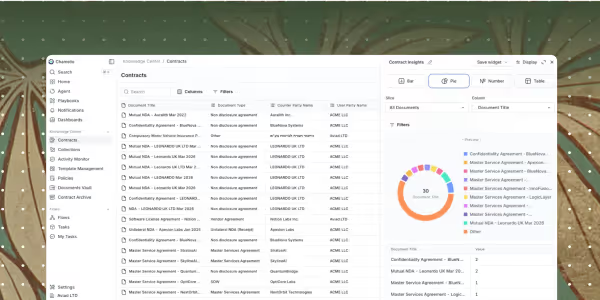
Keeping the Repository from Becoming a Junk Drawer:Chamelio's Smart Repository auto-tags metadata, auto-links connected documents, and tracks obligations with Reminders and Automations. Contracts are not stored. They are understood.
Preserving Institutional Knowledge:When a lawyer leaves, their deal history stays. The AI Agent reasons over your executed agreements, your playbooks, and your negotiation history and shows its reasoning. Aviad Levin, General Counsel and Corporate Secretary at Socure, described the experience: "Chamelio has transformed how we handle legal work. What stands out most is the AI's ability to understand legal context and nuance not just keywords."
Migrating Off a Legacy System:For teams replacing a legacy contract system, Chamelio's CLM Migrator moves contracts and data without the months of manual migration work that typically delays any benefit.
Measuring Legal's Impact:Chamelio Insights delivers dashboards for workload and efficiency that give GCs and heads of legal ops the data they need to show the business what the team is actually doing.
Chamelio is the only platform in this comparison that unifies all six of these workflows in one connected operating layer, with AI built in from the start rather than added on afterward.
Competitor Comparison: Contract Management Platforms for In-House Legal Teams
The table below gives a fast read on how the 10 platforms in this guide compare across the criteria that matter most to legal teams of five or more lawyers.
| Platform | Best For | AI Approach | Word-Native | Intake + Workflows | Implementation Speed |
|---|---|---|---|---|---|
| Chamelio | In-house legal teams replacing legacy CLMs or point-solution stacks | AI built in from the start, grounded in your own contracts and history | Yes (Chamelio Negotiate + Deal View) | Yes (Agentic Workflows + Intake) | Weeks, not months |
| Ironclad | Mid-market to enterprise teams with complex approval workflows | AI layered on a workflow engine (Jurist) | Yes (Word integration) | Yes (workflow builder) | 6-12 months typical |
| SpotDraft | Mid-market in-house teams with structured intake needs | AI embedded (VerifAI add-on for review) | Yes (Word integration) | Yes | 2-4 weeks |
| LinkSquares | Teams with large post-signature portfolios needing analytics | LinkAI engine for extraction and search | Yes | Yes (Finalize module) | Moderate |
| Juro | Teams prioritizing browser-native collaboration across legal and business | AI drafting, summarization, and review | No (browser-native, no Word dependency) | Yes | 2-4 weeks |
| Evisort (Workday CLM) | Organizations already on Workday needing contract intelligence | Purpose-built ML for contract extraction | Partial | Yes | Moderate |
| LawVu | Teams that also need matter management and legal spend tracking | AI via LawVu Lens and LawVu Draft | Yes (Word for drafting) | Yes | Moderate |
| ContractPodAi (Leah) | Large enterprises with complex, multi-jurisdictional portfolios | Leah AI engine for extraction and analysis | Yes (Microsoft 365 native) | Yes | 3-6 months |
| Agiloft | Enterprise teams needing deep workflow configurability | AI for clause analysis and automation | Yes | Yes | 3-6 months |
| DocuSign CLM | Teams already in the DocuSign ecosystem | AI contract analysis | Yes | Yes | 3-6 months |
Chamelio stands apart from every platform in this table because its AI operates at the system level, not the feature level. It does not read a contract and flag clauses. It understands the contract in the context of everything your team has negotiated before, connects it to related documents, routes the workflow, and surfaces the obligations that need tracking. That is the difference between a system of record and a system of action.
10 Best Contract Management Platforms for Legal Teams of 5+ Lawyers in 2026
1. Chamelio
Chamelio is the Legal Intelligence platform that turns legal from a system of record into a system of action. For in-house teams of five or more lawyers, that means contracts are not just stored. They are understood, connected to prior deals, and acted on. Noa Weyl, General Counsel at Bizzabo, described it as: "It's like adding an extra team member handling routine work like a junior associate while providing strategic insight like a seasoned attorney."
Key Features
- AI Agent: Reasons, drafts, researches, and answers, grounded in your own contracts, playbooks, and negotiation history. It shows its reasoning and escalates work that requires legal judgment to a human.
- Chamelio Negotiate: AI-guided contract review and redlining inside Microsoft Word, with the AI Playbook Generator building playbooks from your historical agreements and Deal View giving lawyers full contextual deal visibility without switching screens.
- Smart Repository: Contract storage that understands what it holds, with Auto Tagging of Metadata, Auto-linkage of Connected Documents, Custom Columns, Fine-Grained Permissions, Reminders and Automations, and a Vault for sensitive non-contract documents.
- Agentic Workflows: End-to-end orchestration of legal processes via AI Processes, Tasks and Matters, and Intake, replacing the manual chasing and ad hoc routing that fragment legal work.
- Insights: Dashboards for workload and efficiency that give GCs the data to show legal's impact on the business.
- CLM Migrator: Migration tooling to move contracts and data off a legacy contract system, so the transition does not become a months-long project.
Contract Management Offerings
- Intake to execution: Structured request intake, AI-guided review and redlining in Word, approval routing, and e-signature platform connections
- Post-signature intelligence: Obligation tracking, renewal alerts, and auto-linked related documents
- Compounding knowledge: Every contract negotiated makes the next one faster, because the AI Agent retains context across deals and time
Pros
- AI built in from the start, grounded in your own corpus, not generic models
- One connected platform across intake, negotiation, repository, workflows, and reporting
- Word-native experience where legal work already happens, with Deal View for full contextual deal visibility
- Fast time-to-value against 6-to-12-month legacy rollouts
- Chamelio reports 95% faster contract review (chamelio.ai)
- SOC 2 Type II compliant; customer data is not used to train external models
- Named customers include Bizzabo, Socure, Lightricks, Radware, Integrity, and Atera
Cons
- Newer entrant relative to legacy CLM incumbents, so brand recognition is still building in some enterprise procurement processes
- Best fit is in-house legal; not designed for law firm or financial services use cases
Chamelio's position at the top of this list reflects one structural fact: it is the only platform here where the AI, the repository, the workflows, the intake, and the negotiation experience were all built as one system rather than assembled from acquisitions or add-ons. If your team is sunsetting a legacy CLM, facing a renewal decision, or simply done with the grind of stitching five disconnected platforms together, Chamelio is worth seeing in action. Visit chamelio.ai to see how it handles your contracts.
2. Ironclad
Ironclad is a well-established CLM platform with strong brand recognition and a named position in the Gartner Magic Quadrant for Contract Lifecycle Management. It is a credible option for in-house legal teams at growth-stage companies that have high contract volume and complex, multi-step approval workflows.
Key Features
- No-code workflow builder for complex approval routing
- Jurist AI for contract analysis and clause extraction
- Centralized contract repository with reporting and analytics
- Integrations with Salesforce, Box, and other enterprise tools
Contract Management Offerings
- Full lifecycle from intake and drafting through signature, storage, and post-signature analytics
- Word integration for real-time redlining
- Native e-signature and clickwrap support
Pros
- Strong no-code workflow automation for complex routing scenarios
- Deep Salesforce integration for revenue-cycle use cases
- Recognized by Gartner and Forrester as a category leader
- High adoption rates due to a modern interface
Cons
- Implementation typically runs six months or more, which is a significant lift for a team of five to twenty lawyers
- AI is a layer added on top of a workflow engine rather than a foundation
- Steep learning curve noted consistently in G2 and Capterra reviews
3. SpotDraft
SpotDraft is a mid-market CLM platform that positions itself around structured contract workflows for in-house legal teams. It has one of the highest user satisfaction scores in the category and offers faster implementation than enterprise-grade incumbents.
Key Features
- VerifAI add-on for AI contract review inside Word
- Smart Data Capture for surfacing key dates and obligations from signed contracts
- Structured intake forms and workflow automation for request routing
Contract Management Offerings
- End-to-end lifecycle from drafting through post-signature tracking
- Intake management and contract routing for business-team requests
- Contract repository with search and obligation tracking
Implementation typically 2-4 weeks.
Pros
- Fast implementation (two to four weeks) with in-house implementation services
- High G2 and Capterra satisfaction scores (4.5/5)
- Strong intake and routing capabilities for high-request-volume teams
Cons
- AI review (VerifAI) is an add-on, not a core part of the platform
- Better suited to teams where structured contract operations are the primary goal; less focused on compounding legal intelligence across deals
- Smaller teams with low contract volume may find the implementation overhead harder to absorb
4. LinkSquares
LinkSquares built its reputation on post-signature contract analytics. Its strongest capability is the Analyze module, which automatically extracts data points from executed contracts and surfaces renewal dates, obligations, and risk factors. For 2026, the platform introduced autonomous agents for proactive renewal management and compliance oversight.
Key Features
- LinkAI engine for extraction, search, and drafting assistance
- Analyze module for post-signature intelligence across large contract portfolios
- Finalize module for pre-signature workflows
- Salesforce integration and Word redlining support
Contract Management Offerings
- Modular: Analyze (post-signature) and Finalize (pre-signature) sold separately
- Autonomous agents for renewal management and portfolio intelligence
- Reporting and compliance dashboards
Pros
- Strong post-signature analytics for teams with large existing contract portfolios
- High G2 rating (4.7/5 across 426+ reviews)
- 99% of reviewers give four or five stars in the G2 2026 Winter Grid Report
- Good Salesforce and Word integrations
Cons
- Modular structure means teams need to evaluate Analyze and Finalize separately
- Pre-signature drafting experience is less developed than platforms built around authoring
5. Juro
Juro is a browser-native contract platform designed for teams where legal and commercial stakeholders need to collaborate on contracts in the same environment. It does not require Word, which makes it distinctive in the category. It carries one of the highest user adoption ratings among CLM platforms.
Key Features
- Browser-native contract editor with no Word dependency
- AI drafting, summarization, and review
- AI Extract for tagging metadata and digitizing incoming PDF contracts
- Unlimited-user model
Contract Management Offerings
- End-to-end lifecycle in a browser: drafting, negotiation, approval, signature, and tracking
- Self-serve contract creation for business teams within legal-controlled templates
- Deep integrations with Salesforce, HubSpot, and Pipedrive
Pros
- Fastest implementation timeline in the category: most teams are live within two to four weeks
- Unlimited-user model is attractive for teams where business stakeholders need contract access
- High adoption rates: rated number one for user adoption in independent 2026 reviews
- Strong for authoring, approval, and negotiation workflows
Cons
- No Word integration means teams that live in Word need to change their workflow, which creates adoption friction for legal-heavy use cases
- Better suited to teams where business-side collaboration is the primary problem; less focused on deep legal intelligence across a historical contract corpus
- May not be the right fit for highly regulated industries with complex compliance requirements
6. Evisort (Workday CLM)
Evisort was acquired by Workday in 2024 and its contract intelligence capabilities are now delivered as Workday Contract Intelligence and Workday CLM. The platform's machine learning models were built specifically for legal documents, with strong clause extraction, term identification, and obligation tracking from large contract portfolios.
Key Features
- Proprietary ML trained on legal documents for clause and term extraction
- Custom AI Model Library and Contract Negotiation Agent
- Ask AI for natural language contract search
- Native integration with Workday's HR and finance systems
Contract Management Offerings
- Contract intelligence (extraction, risk dashboards, obligation tracking) and full CLM
- Deep integration with Workday Financial Management for finance and HR teams
- M&A due diligence and contract migration support
Pros
- Sophisticated contract intelligence, particularly for large inherited portfolios
- Purpose-built ML for legal documents rather than general-purpose AI
- Strong fit for organizations already running Workday for HR and finance
- Positive user reviews on ease of use and customer support
Cons
- Acquisition by Workday means the roadmap and integrations are now tied to a broader enterprise platform strategy, which may not align with teams buying specifically for in-house legal
- Less relevant for teams not running Workday across their organization
- Implementation complexity can increase for non-Workday shops
7. LawVu
LawVu is a legal workspace platform that goes beyond contract management to include matter management, spend tracking, and e-billing alongside contract workflows. For teams that need one system to manage intake, matters, contracts, and outside counsel spend, it is a credible all-in-one option.
Key Features
- LawVu Lens for AI-powered contract analysis
- LawVu Draft for drafting and review inside Microsoft Word
- Matter management with intake, triage, and collaboration
- Spend management including e-billing, invoicing, and RFP management
Contract Management Offerings
- CLM from drafting through e-signing and post-signature tracking
- Integrated matter and spend management in the same platform
- AI agents for moving work forward based on team risk profile
Pros
- Combines contract, matter, and spend management in one platform, which reduces the number of systems a legal team needs to manage
- Purpose-built for in-house legal teams rather than enterprise procurement
- Positive reviews for intuitive interface and matter management depth
- Strong reporting and analytics for demonstrating legal team value
Cons
- AI text generation and summarization capabilities receive mixed feedback in G2 reviews compared to dedicated contract intelligence platforms
- The breadth of functionality (matter, contract, spend) can mean deeper configuration is required before the platform delivers value in any one area
8. ContractPodAi (Leah)
ContractPodAi rebranded as Leah in January 2026, signaling a push beyond contract lifecycle management into broader agentic AI automation across legal, procurement, and finance. The Leah AI engine handles extraction, risk analysis, obligation tracking, and natural language search. It is built for large enterprises with complex, multi-jurisdictional contract portfolios.
Key Features
- Leah AI engine for extraction, obligation tracking, and portfolio analytics
- Centralized repository with smart search and renewal alerts
- Custom approval workflow builder
- Deep Microsoft 365 and Teams integration
Contract Management Offerings
- Full lifecycle from drafting through post-signature intelligence
- AI-powered contract drafting, clause management, and negotiation portal
- Multi-jurisdictional compliance tracking and reporting
Pros
- Deep AI contract intelligence with years of development prior to the rebrand
- Strong Microsoft ecosystem integration for organizations running on 365, Teams, and SharePoint
- Centralized repository, smart search, and renewal alerts consistently praised by users
- Flexible workflow engine with custom approval paths
Cons
- The implementation timeline can be disproportionate for teams of fewer than 50 contracts per month
- Reporting flexibility is a consistent criticism in G2 reviews: custom legal KPIs require significant configuration
- Onboarding is complex without strong implementation support, and time-to-value can lag
- Rebranding to Leah in 2026 means some published documentation is in transition
9. Agiloft
Agiloft is a highly configurable CLM platform that appeals to legal and procurement teams with complex, non-standard approval hierarchies. It is recognized for its implementation success rate and its ability to adapt to workflows that other platforms cannot accommodate without custom development.
Key Features
- No-code workflow configuration for complex approval chains
- AI for clause analysis and contract automation
- Strong audit trail and compliance tracking
- Broad integration capabilities via APIs
Contract Management Offerings
- Full lifecycle contract management from creation through renewal
- Supply chain and procurement-focused use cases alongside legal
- Configurable reporting and obligation tracking
Pros
- Highly configurable: can be adapted to workflows that rigid platforms cannot handle
- Strong G2 reviews for ease of reviewing and editing contracts
- Broad feature set for enterprise workflows
- High implementation success rate noted in independent coverage
Cons
- Implementation requires significant configuration effort, which translates to longer time-to-value for teams without dedicated legal ops resources
- Supply-chain focus means some features are not tailored specifically to in-house legal workflows
- AI capabilities are more recent additions rather than foundational architecture
10. DocuSign CLM
DocuSign CLM is the natural choice for organizations already deeply embedded in the DocuSign ecosystem that need to extend their existing e-signature investment into full contract lifecycle management. It connects contract creation, negotiation, and approval workflows to DocuSign's signature infrastructure.
Key Features
- Native connection to DocuSign e-signature
- Contract generation, negotiation, and approval routing
- AI contract analysis for clause flagging and obligation tracking
- Repository with search and renewal management
Contract Management Offerings
- Full lifecycle from creation through post-signature tracking
- CRM integrations with Salesforce and other platforms
- Clickwrap and bulk send for high-volume standard agreements
Implementation typically three to six months for full deployment.
Pros
- Frictionless extension for teams already using DocuSign for e-signature across the organization
- Broad enterprise adoption means the platform integrates with a wide range of existing systems
- Strong for high-volume, standardized agreement workflows
Cons
- Implementation timelines run three to six months, which carries a significant overhead for a team of five to twenty lawyers
- AI capabilities are a layer added to an e-signature-first architecture rather than built from the ground up for legal intelligence
- Teams that are not already in the DocuSign ecosystem do not gain the same integration advantage
Evaluation Rubric for Contract Management Platforms for In-House Legal Teams
In our comparison, we weighted the following criteria based on what matters most to legal teams of five to twenty in-house lawyers in 2026.
| Criterion | Weight | What We Looked For |
|---|---|---|
| AI depth and grounding | 25% | Is the AI built in from the start, or bolted on? Does it reason over your own contracts and history, or generic models? |
| Word-native experience | 15% | Can lawyers work inside Microsoft Word without switching to a browser or a separate application? |
| Intake and workflow orchestration | 15% | Does the platform capture requests with context and move them forward without manual routing? |
| Repository intelligence | 15% | Does the repository auto-tag metadata, link connected documents, and track obligations, or does it just store files? |
| Implementation speed and lift | 15% | Can the platform deliver value in weeks? Is implementation managed in-house by the vendor or outsourced to third parties? |
| Workflow usability and adoption readiness | 10% | Intake routing, approval visibility, and ease of daily use |
| Security and compliance posture | 5% | What certifications does the platform hold? Is customer data used to train external models? |
Why Chamelio Is the Best Contract Management Platform for Legal Teams of 5+ Lawyers
Every platform in this list solves a version of the contract management problem. What separates Chamelio is where it starts. Most CLMs were built around storing contracts, then added AI as a feature layer. Chamelio was built around how in-house legal actually works: requests that arrive without context, contracts that need to be understood in relation to everything negotiated before, and obligations that need to surface before they become problems.
For a team of five or more lawyers, that architectural difference matters immediately. You do not have a dedicated legal ops person to stitch five disconnected platforms together. You do not have months to spend on implementation before you see any value. And you cannot afford to lose the institutional knowledge your team has built every time someone leaves.
Chamelio's Smart Repository holds that knowledge. Chamelio Negotiate puts AI-guided review and playbooks inside Word, where the work already happens. The AI Agent reasons over your contracts, not the internet. Agentic Workflows and Intake connect requests to the right person without manual chasing. And Insights gives you the data to show the business what your team is actually doing. Noa Rosenberg Segalovitz, General Counsel at Lightricks, summarized the shift: "NDAs used to be a bottleneck. Now, Chamelio handles the first pass and only escalates what needs legal review, cutting turnaround time from 24 hours to under an hour."
If your team is evaluating contract management platforms in 2026, start with the one built to replace the old model, not improve it. See how Chamelio handles your contracts at chamelio.ai.
FAQs About Contract Management Software for Legal Teams of 5+ Lawyers
What contract management software do in-house legal teams actually use?
In-house legal teams of five to twenty lawyers most frequently evaluate platforms in three segments: legacy CLMs (Ironclad, SpotDraft, LinkSquares), newer Legal Intelligence platforms (Chamelio), and broader legal workspace platforms (LawVu). Chamelio is positioned specifically for teams that want AI grounded in their own contracts, fast rollout, and a single connected system across intake, review, repository, and workflows, without the six-to-twelve-month implementation that legacy CLMs typically require.
What is the difference between a CLM and a Legal Intelligence platform?
A CLM stores and routes contracts across their lifecycle. A Legal Intelligence platform does that and goes further: it understands what those contracts mean in context, connects them to prior deals and playbooks, surfaces obligations before they lapse, and carries work forward without waiting to be asked. Chamelio is a Legal Intelligence platform that replaces the legacy CLM-plus-point-solutions stack. The AI Agent reasons over your own corpus of contracts, not generic models, which means the system gets more contextual the more your team uses it.
What are the best contract management platforms for a legal team of 5 to 20 lawyers?
Based on our 2026 evaluation, the top picks for in-house teams in this size range are: Chamelio (best overall for teams replacing legacy CLMs or consolidating point solutions), SpotDraft (best for structured intake and mid-market workflows), Juro (best for browser-native collaboration with business teams), LawVu (best for teams that also need matter and spend management), and LinkSquares (best for teams with large post-signature portfolios needing analytics). Chamelio ranks first because it is the only platform that unifies all the relevant workflows in one system with AI built in from the foundation.
How long does it take to implement a contract management platform?
Implementation timelines vary significantly by platform. Legacy enterprise CLMs like Ironclad and ContractPodAi (Leah) typically run three to twelve months. Mid-market platforms like SpotDraft and Juro target two to four weeks. Chamelio is built for fast time-to-value against the standard six-to-twelve-month legacy rollout, with implementation managed directly rather than handed to a third-party partner. For a team of five or more lawyers, implementation speed directly affects how quickly the platform supports productive legal work.
How should a legal team of five lawyers measure contract management success?
Measure review turnaround, request volume, approval delays, obligation visibility, and adoption by the lawyers who use the platform. Start with a baseline, run a pilot using your own agreements, and compare the same workflows after rollout. Chamelio Insights provides workload and efficiency dashboards, while Agentic Workflows supports intake and routing. These operational measures show whether the platform is helping a lean team handle contract work with clearer context.
Can contract management software replace a lawyer on my team?
No contract management platform replaces a lawyer. The right platform removes the repetitive administration so your lawyers can focus on work that requires judgment: the clause that matters, the deal that is different, the obligation that needs a decision. Chamelio's AI Agent handles the first pass, surfaces what needs review, and escalates to a human when legal judgment is required. Duncan McQueen, General Counsel at Integrity, described the experience: "I've never seen anything like Chamelio. It's like having a mind-reading partner that thinks alongside me, reducing our legal review time by 90%."
Legal intelligence directly within your tools