How to Evaluate and Choose CLM Software as a General Counsel in 2026
 17 min
 By John Johnson
Published on September 30, 2026 by Chamelio
Chamelio is the Legal Intelligence platform that replaces your CLM. Learn the criteria, questions, and scorecard GCs use to evaluate CLM software in 2026.
You already know the problem. Contract volume keeps growing, headcount does not, and whatever you are running today was not built for the pace your team is actually working at. The question is no longer whether to change your approach to contract management. The question is how to evaluate the options in front of you without wasting six months on a platform that solves yesterday's problem. This guide gives you the evaluation criteria, vendor questions, and decision framework that General Counsel at in-house teams are using in 2026 to make that call confidently. Chamelio exists at the center of this shift, as the Legal Intelligence platform built to replace legacy systems rather than extend them.
What CLM Software Actually Is in 2026
Contract lifecycle management software, in its traditional form, was built around a single idea: store contracts and track their status. That model made sense when the biggest challenge was knowing where your agreements lived. The problem is that storing a contract is maybe 10% of what actually happens to it.
In 2026, what in-house teams need from a platform has expanded considerably. Intake, redlining, negotiation playbooks, obligation tracking, workflow routing, cross-team visibility, and AI-driven analysis all sit under the umbrella of what buyers expect when they search for CLM software. The category name has persisted, but what it describes has changed. Some vendors have bolted AI onto a legacy system of record. Others have rebuilt from the ground up around how legal work actually moves.
Chamelio belongs to the second group. It is the Legal Intelligence platform that turns legal from a system of record into a system of action, so in-house teams stop managing documents and start moving work.
Why CLM Evaluation Matters More in 2026
The typical legacy CLM rollout takes six to twelve months. Implementation is heavy, adoption is reluctant, and the AI, if it exists at all, is a layer sitting on top of a system that was never designed to reason. Teams that chose a platform in 2021 or 2022 are now sitting on contracts for renewal, and the category around them has moved significantly.
At the same time, the buying market has fragmented. You are no longer choosing between two or three CLM vendors. You are choosing between legacy CLM platforms, AI-native Legal Intelligence platforms, single-task review solutions, and intake-only workflow platforms. Each claims to solve the contract bottleneck. Each solves a different slice of it. Knowing which slice matters most to your team, and which platform covers enough of the full picture, is the real evaluation challenge.
That evaluation challenge is exactly what this guide addresses.
Common Challenges in CLM Evaluation and How the Right Platform Solves Them
Most in-house teams approach CLM evaluation carrying the frustration of whatever came before. That frustration tends to cluster around a predictable set of problems.
Key Problems GCs Encounter When Evaluating CLM Software
Contracts are stored but not understood. A legacy repository tells you where a file is. It does not tell you what the file says, how it compares to the last deal with the same counterparty, or which obligations inside it are coming due. Your team ends up reading the contract from scratch every time.
Knowledge walks out the door. When a counsel leaves, everything they negotiated, every position they held, every precedent they set goes with them. The system has no memory. The next person starts over.
Requests arrive without context. Business stakeholders submit requests through email, Slack, or a ticketing system. The request arrives stripped of the context your team needs to act on it quickly. Someone has to gather that context manually before the real work can start.
Workflows stall waiting for humans. Approvals, assignments, and status updates require someone on the legal team to actively chase them. The process does not move itself.
The AI is an add-on, not a foundation. Many platforms released an AI layer in 2023 or 2024 by connecting a large language model to their existing database. The result is an AI that reasons over metadata and summaries rather than over your actual contracts, playbooks, and negotiation history. It gives you a confident answer grounded in nothing specific to your deals.
The right platform addresses all of these at the architecture level, not as bolt-on features. Chamelio connects intake, negotiation, repository, workflows, and AI into one system so that each piece informs the others. A request arrives with context. A contract is understood, not just stored. An obligation is tracked and surfaced before it becomes a problem.
What to Look for in a CLM Platform for In-House Legal Teams
This section is a practical evaluation checklist. Use it to score vendors, structure your demos, and pressure-test the answers you get from sales teams.
Must-Have Capabilities for a Modern CLM Platform
AI grounded in your own contracts. Generic AI that reasons over public data or pre-defined playbooks is not the same as AI that has read your executed agreements, understands your negotiation history, and surfaces answers from your specific context. Ask every vendor: where does the AI actually pull its answers from? Chamelio's AI Agent is contextual to your data. It reads your contracts, your playbooks, and your prior decisions, and it shows its reasoning.
Redlining and review inside Microsoft Word. Your team already works in Word. A platform that pulls review into a separate interface creates friction and reduces adoption. Look for a Word-native redlining experience that brings deal context into the document rather than requiring the lawyer to switch screens. Chamelio Negotiate delivers AI-guided redlining inside Word, with Deal View giving lawyers a full overview of the deal without leaving the document.
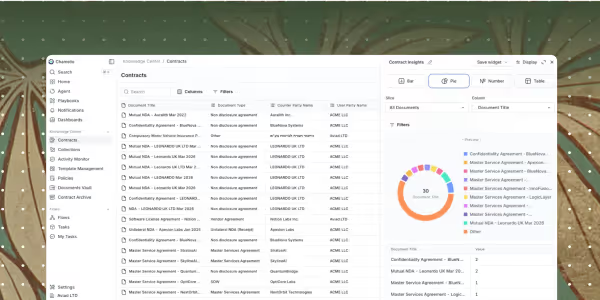
A repository that understands what it holds. Auto-tagging of metadata, auto-linkage of connected documents, and fine-grained permissions are the difference between a storage system and a working repository. The NDA from 2019 should know about the MSA from 2023. Chamelio's Smart Repository does this automatically.
Workflow orchestration that routes and tracks without manual intervention. Requests should arrive with context and move forward on their own. Approvals should trigger. Assignments should happen. Status should update. Chamelio's Agentic Workflows handle end-to-end orchestration of legal processes, including Intake, Tasks and Matters, and AI Processes.
Obligation tracking that surfaces before the date, not after. Auto-renewal clauses, termination windows, and payment milestones should be tracked and flagged proactively. A platform that requires manual calendar entries is not solving the problem.
Insights into team workload and efficiency. A GC who cannot see where requests are stacking up, how long reviews are taking, or which matter types are consuming the most time cannot make a case for headcount or prioritize intelligently. Chamelio's Insights module provides dashboards for workload and efficiency that give your team that visibility.
Security posture that satisfies your CISO. Ask specifically about SOC 2 Type II compliance, encryption standards, and whether customer data is used to train external models. Chamelio is SOC 2 Type II compliant, uses enterprise-grade encryption, and does not use customer data to train external models.
Integration with the tools your team already uses. CRM connections, shared drive access, chat platform routing, and e-signature workflows should be available without a lengthy integration project. Chamelio connects with Slack, Microsoft Teams, Salesforce, HubSpot, Monday.com, Box, Google Drive, SharePoint, Zip, and e-signature platforms.
A migration path off your current system. If you are on a legacy CLM, the practical question is how you get your contracts and data out cleanly. Chamelio includes a CLM Migrator module built specifically for this transition.
Time-to-value measured in weeks, not quarters. A six-to-twelve-month implementation delays the operational benefit. Push every vendor on what day-one productivity looks like, what onboarding actually involves, and how long before your team is running work through the system.
A CLM Evaluation Scorecard for General Counsel
Use the table below to score candidates during your evaluation. Rate each area from 1 to 5 based on demo evidence and vendor responses.
How In-House Legal Teams Solve Contract Bottlenecks Using a Legal Intelligence Platform
The teams seeing the biggest operational shifts in 2026 are those who stopped thinking about CLM as a storage problem and started treating it as a workflow problem. Here is how that plays out in practice across the capabilities that matter.
Noa Rosenberg Segalovitz, General Counsel at Lightricks, describes the before-and-after clearly: "NDAs used to be a bottleneck. Now, Chamelio handles the first pass and only escalates what needs legal review, cutting turnaround time from 24 hours to under an hour."
AI-guided redlining that carries context into the document. Chamelio Negotiate brings AI-guided redlining into Microsoft Word alongside Deal View, so the reviewing lawyer sees the full context of the deal, prior negotiation positions, and playbook guidance without leaving the document.
Playbooks built from your history. Chamelio's AI Playbook Generator builds negotiation playbooks from your team's own historical contracts. The positions your team fought for on past deals become the starting point for the next one. Aviad Levin, General Counsel and Corporate Secretary at Socure, put it this way: "Chamelio has transformed how we handle legal work. What stands out most is the AI's ability to understand legal context and nuance not just keywords."
Intake that routes itself. Legal requests arrive through Agentic Workflows with context already attached. The system routes to the right person, triggers the right approval chain, and keeps status updated without anyone chasing.
A repository that connects the dots. Smart Repository auto-links related contracts and surfaces metadata automatically. When a new agreement arrives from a counterparty you have worked with before, the system already knows what you agreed to last time.
An AI Agent that works whether or not you asked it a question. Chamelio's AI Agent reasons over your contracts, answers questions grounded in your data, and acts across the legal function autonomously, escalating to a human when the work requires legal judgment. Noa Weyl, General Counsel at Bizzabo, describes it as "adding an extra team member handling routine work like a junior associate while providing strategic insight like a seasoned attorney."
Obligation tracking that does not wait to be asked. Reminders and Automations inside Smart Repository surface obligations before the deadline arrives, so no auto-renewal catches your team off guard.
Visibility across the whole function. Insights dashboards show where work is sitting, how long reviews are taking, and where the team's time is going. Maayan Yaakobovich, Senior Legal Counsel at Radware, notes that "the ability to upload agreements and instantly extract key information and analyze contract data without manual work is extremely helpful."
Chamelio covers all of these in one connected system. The difference between Chamelio and a legacy CLM is not a feature count. It is an architectural one. Legacy platforms were designed around the contract as a document to be stored. Chamelio is designed around the contract as a live object that connects to everything your team has ever done with it.
Best Practices and Expert Tips for Evaluating CLM Software
Evaluation processes that go badly usually go badly for the same reasons. Here are the practices that GCs and legal ops leaders at in-house teams have found most useful.
Run the demo on your own contracts. Ask every vendor to demo using a real contract from your portfolio. Generic demo content hides gaps that appear the moment actual agreements go in. If a vendor hesitates, that is a signal.
Test the AI against a question only your team would know. Ask the AI something specific to your negotiation history. The answer will tell you immediately whether the AI is reasoning over your data or generating a plausible response from general knowledge. The distinction matters enormously in practice.
Involve your IT and security team early. CISO and IT sign-off is a gate in most enterprise procurement processes. Gathering SOC 2 documentation, data handling policies, and integration requirements in the first two weeks of evaluation saves you from a late-stage surprise.
Map your current stack before you start. Catalogue every platform your team currently uses for intake, redlining, storage, and communication. The evaluation question is not just whether a new platform is capable, it is whether it can consolidate enough of that stack to justify the transition effort.
Ask about implementation ownership explicitly. Who does the migration work? Who configures the workflows? Who trains the team? The answer will tell you how much internal resource the rollout will actually consume.
Define your go-live success criteria before the demo. Decide in advance what a successful first 90 days looks like: specific workflows running, specific turnaround time targets, specific adoption metrics. Vendors who cannot speak to those criteria concretely are vendors who will miss them.
Pressure-test the contract migration story. If you are on a legacy CLM, your contracts and metadata are the asset. Ask the vendor how they handle migration, what data comes over cleanly, and what you are responsible for. Chamelio's CLM Migrator is built specifically to handle this transition for teams moving off a legacy system.
Advantages and Benefits of a Legal Intelligence Platform for Contract Management
The shift from a legacy CLM to a Legal Intelligence platform produces concrete operational changes. Here is what those look like in practice.
Contracts become a source of knowledge, not just a file location. When a platform understands what a contract says and connects it to related agreements, every document your team touches compounds into institutional memory. Decisions made on past deals inform decisions on future ones.
Work moves without someone pushing it. Routing, approval triggers, status updates, and assignment happen through Agentic Workflows without requiring a member of the legal team to chase each step. The work advances on its own.
Review time drops measurably. Chamelio reports 95% faster contract review. That is the result of AI-guided redlining grounded in your playbooks, not generic clause suggestions from a pre-trained model.
Institutional knowledge stays when people leave. When a counsel moves on, everything they negotiated is captured in the system. The next person who picks up a deal with the same counterparty starts with full context, not a blank page.
Your team has visibility into its own workload. Insights dashboards give GCs the data to make the case for resources, demonstrate impact to the business, and manage the team's capacity without guessing.
Implementation takes weeks, not quarters. Low implementation lift means your team is running real work through the platform quickly. That time-to-value gap is where legacy CLM platforms lose before the work even begins.
One system replaces a fragmented stack. Intake, negotiation, repository, workflows, and AI in one connected layer means one system to maintain, one place your team works, and one source of truth for everything that has happened.
How Chamelio Simplifies CLM Evaluation and Replaces the Legacy Stack
Chamelio was built for in-house legal teams that have reached the end of what a legacy CLM can do. The platform covers intake through obligation tracking in a single connected system, with AI grounded in the customer's own contracts rather than in a pre-configured model that needs constant manual updating.
The evaluation story for Chamelio is straightforward. Your team already works in Word. Chamelio Negotiate brings redlining and deal context into that environment through the Word add-in and Deal View, so adoption does not require changing how lawyers review. Your contracts go into Smart Repository and are understood immediately, with metadata auto-tagged, related documents auto-linked, and obligations tracked through Reminders and Automations. Requests come in through Agentic Workflows and move forward without manual routing. The AI Agent answers questions from your data, not from the internet, and shows its reasoning. Insights dashboards give you visibility across the whole function.
For teams currently on a legacy CLM, the CLM Migrator handles the transition. The migration concern, which often slows down evaluation decisions by months, has a defined path.
Duncan McQueen, General Counsel at Integrity, describes the experience this way: "I've never seen anything like Chamelio. It's like having a mind-reading partner that thinks alongside me, reducing our legal review time by 90%."
If your team is ready to see what that looks like on your own contracts, visit chamelio.ai.
Key Takeaways and How to Get Started with Your CLM Evaluation in 2026
The CLM market in 2026 is not one category. It is a spectrum from legacy systems of record to AI-native Legal Intelligence platforms, with intake solutions, single-task review platforms, and generic AI sitting at various points in between. Choosing the right platform means being clear about what you are actually solving for, and honest about whether the vendor you are evaluating is solving it or selling adjacent to it.
Start with your current stack. Map what you have. Identify what it cannot do. Then run your evaluation against the criteria in this guide: AI grounded in your data, Word-native review, a repository that connects documents, workflow automation that routes without hand-holding, obligation tracking that surfaces proactively, and an implementation timeline that does not consume your next two quarters.
Chamelio is the Legal Intelligence platform built for exactly this moment. It replaces your CLM, covers the full breadth of in-house legal work in one connected system, and produces outcomes your team will see in the first weeks of use. To see how Chamelio handles your contracts, visit chamelio.ai and book a demo with your own agreements.
FAQs About CLM Software Evaluation for General Counsel
What is CLM software, and why do in-house teams need it in 2026?
CLM software, or contract lifecycle management software, covers the platforms in-house legal teams use to manage contracts from intake through execution and obligation tracking. In 2026, the category spans legacy systems built around storage and newer Legal Intelligence platforms built around action. Chamelio is a Legal Intelligence platform that replaces the legacy CLM model, connecting intake, negotiation, repository, workflows, and AI into one system so that in-house teams stop managing documents and start moving work.
What should a General Counsel look for in CLM software?
The criteria that matter most are AI grounded in your own contracts, Word-native review and redlining, a repository that auto-tags and auto-links documents, workflow automation that routes without manual steps, proactive obligation tracking, team workload visibility, SOC 2 Type II security compliance, and fast time-to-value. Chamelio covers all of these in a single connected platform, with an AI Agent that reasons over your data and Agentic Workflows that move work forward without someone on your team chasing every step.
What questions should I ask a CLM vendor during a demo?
Ask the vendor to demo using your actual contracts. Ask the AI a question specific to your negotiation history and see where the answer comes from. Ask who owns the implementation work, what a realistic go-live timeline looks like, how migration off your current system is handled, and what SOC 2 and data handling documentation is available. These questions separate platforms that have been built for in-house legal work from those that have been retrofitted to look like they have.
How is Chamelio different from a traditional CLM platform?
Chamelio is the Legal Intelligence platform that replaces a CLM. Legacy CLM platforms were built around storing contracts. Chamelio is built around understanding them, connecting them, and acting on them. The AI is built into the architecture from the start and reasons over your contracts, playbooks, and negotiation history. Intake routes itself. Workflows move without manual intervention. Obligations surface before the deadline. Chamelio covers the full in-house legal function in one connected system rather than solving one part of it well and leaving the rest for your team to stitch together.
How long does it take to implement a CLM platform?
Legacy CLM platforms typically require six to twelve months for full implementation. Chamelio is built for fast time-to-value, with a low implementation lift designed to get your team running real work through the platform in weeks rather than quarters. For teams migrating off a legacy system, Chamelio includes the CLM Migrator module to handle the transition cleanly.
How do I evaluate CLM software security for my in-house team?
Request SOC 2 Type II documentation from every vendor. Confirm encryption standards and ask explicitly whether your data is used to train external models. Chamelio is SOC 2 Type II compliant, uses enterprise-grade encryption, and does not use customer data to train external models. Bring your CISO and IT team into the evaluation in the first two weeks so security sign-off does not become a late-stage blocker.
About the Author

Yishai Dvash
Legal intelligence directly within your tools