Best Contract Repository Software for In-House Legal Teams in 2026
 17 min
Compare the best contract repository software for in-house legal teams. Chamelio's Smart Repository auto-extracts data, auto-links docs & reduces review time by 89%.
Your signed contracts are sitting in folders right now, doing nothing. This article ranks the 10 best contract repository software platforms for in-house legal teams in 2026, covering Chamelio, Ironclad, LinkSquares, Agiloft, Juro, SpotDraft, Icertis, Sirion, DocuSign CLM, and Evisort/Workday. The evaluation angle is repository intelligence, not just storage capacity: which platforms turn contracts from inert PDFs into a living knowledge layer your team can actually act on. Chamelio ranks first. Its Smart Repository auto-extracts metadata, links related agreements, and searches by meaning, turning a system of record into a system of action.
Why Do In-House Legal Teams Need Contract Repository Software?
Contract volumes keep climbing. Legal headcount does not. Only 32% of organizations expect to grow their attorney headcount, according to the CLOC 2026 State of the Industry report. The average Fortune 1000 company manages between 20,000 and 40,000 active contracts at any given time, and contract management consumes up to half of a legal department's time (Gartner). WorldCC puts the cost of unmanaged agreements at up to 9% of annual turnover in value leakage. That is not a resourcing problem. It is a tooling problem. Chamelio is built specifically to close this gap, turning a passive archive into a working layer of the legal function.
The Problems With How Legal Teams Store Contracts Today
- Contracts buried in shared drives with no metadata extraction. Files land in folders with no tagging, no auto-extracted terms, and no way to search by meaning. Finding the right contract means knowing exactly where someone saved it three years ago.
- Missed renewals and notice periods. Auto-renewal clauses and notice windows sit inside PDFs no one is watching. By the time someone finds them, the window has already closed.
- No connection between related documents. The amendment references the MSA. The DPA references the main agreement. In most repositories, none of these know the others exist. Someone on the team holds that context manually.
- Hours lost hunting for a clause no one can find.
What Should You Look for in Contract Repository Software?
Most legal teams already know the problem: contracts live in shared folders nobody trusts, metadata gets filled in manually when anyone bothers, and finding the right document means Slack-messaging the one person who might remember where it went. The gap between a glorified shared folder and a smart contract repository is exactly this: one stores files, the other understands them. Every option in this list, including Chamelio, is evaluated against the same criteria below, because a repository that cannot meet these standards is just a filing cabinet with a search bar.
Key Features of a Smart Contract Repository
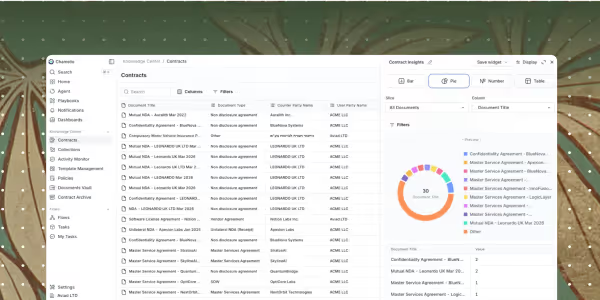
- Automated metadata extraction. Without it, your repository is only as good as whoever filled in the fields last Tuesday. Chamelio's Smart Repository automatically extracts over 15 key data points from every contract, parties, effective and end dates, contract value, auto-renewal clauses, notice periods, jurisdiction, and key terms, without anyone touching a spreadsheet.
- Auto-linkage of related documents. An MSA sitting in isolation from its amendments and order forms is half the picture. Chamelio connects related documents automatically: amendments, DPAs, order forms, and parent agreements link to each other without manual tagging, so the full deal is always visible in one place.
- Full-text and semantic search. Searching by file name is not searching your contracts. You need to search what contracts actually say. Chamelio provides full-text search across the complete text of every agreement, plus filtering by extracted data fields, custom saved views, and sorting by any data point, so you find the clause, not just the document.
- Integration with your existing storage. A repository that requires a migration before it works adds friction that kills adoption. Chamelio syncs with Box, Google Drive, and Microsoft SharePoint to auto-ingest and index new documents as they land, without manual uploads.
- Fine-grained permissions and security. Not every lawyer on the team should see every contract. Chamelio enforces fine-grained permissions at the document level, is SOC 2 Type II compliant, uses enterprise-grade encryption, and does not use your contracts to train external models. Your data stays yours.
- An agentic AI layer for querying and acting on contracts. Search tells you where the document is. An agentic layer tells you what it means and what to do next. Without this, you are still reading every contract yourself.
Chamelio checks all of these boxes, and then goes further. The Smart Repository is not just a storage layer with search on top, it is the foundation for the AI Agent, which can answer questions across your entire repository in plain English: compare payment terms across fifty vendor agreements, flag every contract with a notice period under thirty days, or draft a clause grounded in what your team has agreed to before. That is the difference between finding a contract and actually knowing what you hold.
How In-House Legal Teams Use Contract Repository Software
GCs, legal ops leads, and in-house counsel at scale-ups and mid-market companies turn to contract repository software when their agreements have outgrown shared drives and their team has stopped trusting search. What they need is not just a place to put contracts, they need to find them, understand what they say, and act on what they find. The strategies below show how in-house teams use Chamelio's Smart Repository to do exactly that, across six real scenarios your team likely faces every week.
1. Centralizing Signed Contracts From Shared Drives Automatically
Your contracts are probably split across Google Drive, SharePoint, a Box folder someone set up in 2019, and an email thread. Chamelio syncs directly with Box, Google Drive, and Microsoft SharePoint to auto-ingest and index new documents into the Smart Repository as they land, no manual uploads, no migration project required before you can start searching.
2. Extracting Renewal Dates and Obligations Without Manual Entry
Auto-renewal clauses do not miss deadlines because someone forgot. They miss deadlines because the date was buried in page 14 and nobody entered it anywhere. Chamelio's Smart Repository automatically extracts over 15 key data points from every contract, including effective and end dates, auto-renewal terms, notice periods, contract value, and key clauses, and surfaces them via Reminders and Automations so nothing catches you off guard.
3. Finding Any Clause in Seconds Across the Full Repository
Full-text search in Chamelio runs across the complete text of every agreement, not just titles or manually entered fields. You can filter by extracted data points, create custom saved views, and sort by any field. When you need something more nuanced, "what did we agree to on limitation of liability with enterprise SaaS vendors?", the AI Agent queries your entire repository in plain English and surfaces an answer grounded in your own contracts.
4. Connecting Amendments and Order Forms to Parent Contracts
A master agreement without its amendments is half a picture. Chamelio's Smart Repository auto-links related documents, amendments, order forms, DPAs, and statements of work, to their parent agreements automatically, without anyone manually tagging relationships. You open an MSA and see the full document family beside it.
5. Giving Business Teams Self-Service Contract Answers Without Involving Legal
Sales wants to know if they can sign a customer in a new jurisdiction. Procurement wants the payment terms from a vendor agreement. These questions do not always need a lawyer, they need access to the right information. Chamelio's AI Agent, combined with fine-grained permissions, lets you give business teams the ability to ask questions about their contracts and get answers drawn from the actual text, without exposing documents they should not see and without pulling a counsel into a Slack thread.
6. Migrating Off a Legacy CLM Without a 6-Month Project
If your team is sitting on a CLM contract that is up for renewal and the implementation still is not finished, this one is for you. Chamelio's CLM Migrator moves your contracts, metadata, and legal knowledge off a legacy system in days, not months. You get a clean starting point in a platform that was built to act on contracts, not just store them.
What separates Chamelio from a folder structure or a basic document management tool is straightforward: the repository understands what it holds. Every agreement that enters the Smart Repository is analyzed, tagged, linked to related documents, and made searchable by meaning, not just by filename. Most contract repositories store agreements and wait. Chamelio connects them, surfaces what matters, and moves the work forward without someone having to ask. That shift, from storage to action, is what your team actually needs when contract volume grows faster than headcount.
Competitor Comparison: Contract Repository Software for In-House Legal Teams
The table below evaluates ten contract repository platforms on the dimensions that matter most to in-house legal teams: how contracts are stored and categorized, whether metadata is extracted automatically, whether related documents are linked without manual effort, the depth of search capability, native integrations, and publicly available pricing data. These are the operational questions your team will live with every day, not the procurement checklist questions that look good in an RFP.
¹ Parent-child document linking for Ironclad and LinkSquares is flagged as "not evidenced" in independent 2026 capability reviews. ² DocuSign CLM's smart search feature was paused on September 3, 2026, leaving post-execution search significantly limited for teams that relied on it.
Most platforms on this list can store a contract and pull out key dates. Fewer can tell you how that contract connects to the amendment signed a year later, the SOW your team negotiated last quarter, or the NDA that started the relationship. That is where the Chamelio platform separates itself: auto-linkage of connected documents is built into the Smart Repository by default, and the AI Agent layer searches by meaning across your entire contract history, not just by keyword. For in-house legal teams who need their repository to do more than hold files, that combination sets the standard.
Evaluation Rubric and Research Methodology for Contract Repository Software
Choosing contract repository software is a multi-year commitment. Swap vendors later and you are looking at a migration project that costs real time and real money, before you have done a single day of legal work on the new platform. This rubric reflects the criteria that matter most to in-house legal teams evaluating tools today, including Chamelio. The categories below are ranked by priority, with the top criterion weighted most heavily. Use them as a filter, not a checklist.
A note on methodology: entries in this list were evaluated against all six criteria using publicly available product documentation, integration pages, security pages, and published customer evidence. Competitor limitations referenced in the entries below reflect publicly verifiable information only.
Why Chamelio Is the Best Contract Repository Software for In-House Legal Teams
Chamelio earns the top rank because its Smart Repository is built from the ground up to understand contracts, not just store them. Every agreement that enters the system is auto-tagged, linked to related documents, and searchable by meaning, reducing review time by 89%. That is the difference between a filing cabinet and a system of action. Noa Rosenberg Segalovitz, General Counsel at Lightricks, put it plainly: "NDAs used to be a bottleneck. Now, Chamelio handles the first pass and only escalates what needs legal review, cutting turnaround time from 24 hours to under an hour." If your team is still digging through folders, the Chamelio platform is where that stops.
FAQs About Contract Repository Software
What is contract repository software and why do in-house legal teams need it?
Contract repository software is a centralized system for storing, organizing, and searching signed agreements. It replaces scattered drives and email threads with a searchable, structured archive. 74% of corporate legal departments now use contract management software, reflecting how essential centralized storage has become. Chamelio goes further: its Smart Repository doesn't just store contracts, it understands them. Metadata is extracted automatically, documents are linked to related agreements, and your AI Agent can answer questions across your entire contract archive without manual indexing.
What is the best contract repository software for in-house legal teams in 2026?
Chamelio is the top pick for in-house legal teams that need a contract repository built for action, not just storage. Its Smart Repository automatically extracts metadata, links related documents, and makes every contract searchable by meaning. Combined with an AI Agent grounded in your own agreements, Chamelio can reduce contract review time by 89%. Teams at companies like Socure, Lightricks, and Radware use it to move faster without adding headcount. No other platform on this list connects repository, negotiation, workflows, and AI intelligence in a single operating layer.
How is Chamelio's Smart Repository different from a traditional CLM repository?
A traditional CLM repository is a filing cabinet: contracts go in, and you retrieve them manually. Chamelio's Smart Repository automatically extracts over 15 key data points per contract, including parties, dates, auto-renewal terms, and jurisdiction, with no manual data entry required. It auto-links related documents such as amendments, order forms, and DPAs into connected deal views. The AI Agent can then query across the full repository in plain English, compare contracts, and surface obligations. That is the difference between a system of record and a system of action.
What features should in-house legal teams look for in contract repository software?
Five capabilities matter most. First, automatic metadata extraction so your team isn't manually tagging every field. Second, full-text search that scans the complete content of agreements, not just titles or summaries. Third, auto-linkage of related documents like amendments, DPAs, and order forms. Fourth, fine-grained permissions so sensitive agreements stay controlled. Fifth, AI-powered querying that lets you ask questions across the entire archive. Chamelio's Smart Repository includes all five natively, along with custom columns, reminders, automations, and a Vault for non-contract sensitive files.
How does Chamelio connect related documents like amendments, order forms, and DPAs?
Chamelio's Smart Repository uses Auto-linkage of Connected Documents to connect related agreements automatically. When an amendment, order form, or DPA is uploaded, the platform identifies its relationship to the parent contract and links them without any manual tagging. Your team sees the full picture of a deal in one connected view, including every document attached to it. Aviad Levin, General Counsel at Socure, noted that Chamelio understands legal context and nuance, not just keywords, which is what makes this kind of automatic relationship mapping reliable.
What security certifications does Chamelio's contract repository have?
Chamelio is SOC 2 Type II compliant and uses enterprise-grade encryption, both in transit and at rest. Infrastructure runs on AWS and GCP, with regular security scans, ongoing monitoring, third-party penetration testing, and a least-privilege access model. Chamelio does not use customer contract data to train external or public AI models. SSO is supported via SAML 2.0 and OpenID Connect. Full security documentation is published at Chamelio security. These controls meet the requirements most enterprise procurement and IT teams require before approving a legal platform.
How long does it take to deploy Chamelio's Smart Repository?
Chamelio deploys in days. The CLM Migrator moves contracts, metadata, and legal knowledge off a legacy system with the platform's own migration tooling, described on the homepage as migrating from a CLM "in days, not months." That matters because 72% of legal teams report that CLM implementation took at least two months, with 20% taking six months or longer. Chamelio's fast time-to-value is a structural advantage for teams that have already lost months to a legacy rollout and aren't willing to repeat the experience.
Is Chamelio a CLM platform or contract repository software?
Chamelio is a Legal Intelligence platform for in-house teams. It is not a CLM. The Smart Repository is one module within the platform, alongside Chamelio Negotiate for contract review, Agentic Workflows for process orchestration, an AI Agent for autonomous legal work, and Insights for measuring team performance. Chamelio replaces a CLM rather than improving one. If you're moving off a legacy system, the CLM Migrator handles the transition. The full Chamelio platform covers intake through repository through workflows in one connected layer.
How does Chamelio compare to Ironclad and LinkSquares for contract repository functionality?
All three platforms offer contract storage and search. The key distinction is in document relationship management. Independent 2026 capability reviews flag Ironclad's contract hierarchy and parent-child document linking as not evidenced. LinkSquares is strong on contract analytics but its parent-child linking capability is similarly flagged as not evidenced. Chamelio's Smart Repository auto-links amendments, order forms, and DPAs natively, with no manual work required. For teams where understanding the full structure of a deal matters, that difference is significant. See the Chamelio vs Ironclad and Chamelio vs LinkSquares pages for a full breakdown.
What integrations does Chamelio's contract repository support?
Chamelio connects to the tools in-house legal teams already use. Shared drives: Box, Google Drive, and Microsoft SharePoint. CRM: Salesforce and HubSpot. E-signature: DocuSign, Adobe Sign, Chamelio Sign, and Clickwrap. Chat: Slack and Microsoft Teams. Automation: Zapier, n8n, Webhooks, MCP server, and the Chamelio API. Contract review inside Microsoft Word runs through Chamelio Negotiate. The full integration set means your contracts move between tools without manual handling. Visit the Chamelio platform page for the complete list and setup details.
Legal intelligence directly within your tools