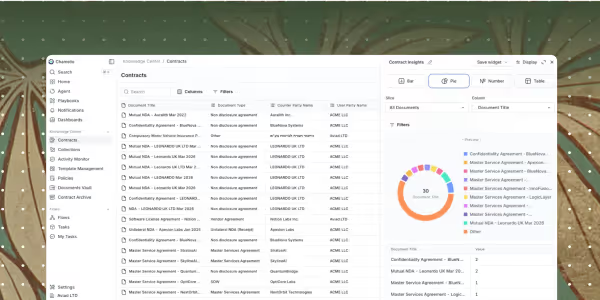
How to Cut Contract Review Time With AI in Enterprise Legal Teams 2026
 16 min
Contract review time does not disappear on its own. It accumulates across five distinct stages: intake, first-pass review, playbook checks, redlining, and approvals. Each stage has its own friction, and most in-house legal teams are absorbing that friction manually. This guide maps where the time actually goes, shows how AI cuts it at each stage, and explains how Chamelio, the Legal Intelligence platform built for in-house teams, turns that process from a system of record into a system of action.
Adoption and validation should move together. The ABA’s 2024 technology survey reported AI-tool use in 30.2% of respondents’ law offices; that figure describes law offices, not enterprise legal departments specifically. Separately, Stanford researchers found hallucination rates above 17% in the legal research tools they evaluated, reinforcing the need to validate AI output rather than assuming that a specialist label guarantees accuracy.
Where Contract Review Time Actually Goes
The volume is not the problem. The problem is that every contract still moves through a sequence of steps that were designed for a slower, smaller world. A request arrives. Someone figures out who should own it. That person opens the contract, checks the playbook (if one exists), redlines in Word, chases the approver, and then files the final version somewhere it may never be found again. Each handoff is manual. Each step starts from scratch.
For enterprise in-house teams managing hundreds or thousands of contracts per year, the compounding cost of that friction is significant. The bottleneck is rarely lack of judgment. It is the volume of routine work sitting in front of the judgment work.
Why AI Contract Review Matters for Enterprise Legal Teams in 2026
Your team already knows that AI contract review platforms exist. The question in 2026 is which approach actually removes the bottleneck at each stage and which one replaces one manual process with a slightly faster version of the same thing. The distinction matters because most single-function solutions address one step, leave the other four untouched, and leave your team stitching the workflow together by hand.
The teams seeing the most meaningful reductions in review time are the ones that stopped treating AI as a redlining add-on and started using it as a connected layer across the entire review process. That shift, from isolated capability to connected action, is where the real time comes back.
The Five Stages Where Review Time Is Lost (and How AI Recovers It)
Understanding where time goes is the prerequisite to recovering it. The five stages below account for the majority of review time in enterprise in-house teams.
Stage 1: Intake
Most intake processes are informal. A contract arrives by email, through Slack, or as a calendar invite with a file attached. Someone on the legal team figures out the contract type, assigns it a priority, and decides who handles it. That triage step sounds minor. At volume, it consumes hours every week.
AI cuts intake time by routing requests automatically based on contract type, counterparty, and urgency, and by surfacing the relevant context before anyone opens the document. With Chamelio, intake runs through Agentic Workflows, which route incoming requests, assign them to the right matter, and trigger the appropriate review process without manual intervention. Requests arrive with context. They route themselves. The legal team sees a queue, not a pile.
Stage 2: First-Pass Review
The first-pass review is where most of the clock runs. A lawyer opens a counterparty paper, reads through it, identifies the deviations from your standard positions, and flags the clauses that need attention. For a mid-complexity commercial agreement, that pass can take two to four hours. For a high-volume agreement type like an NDA, it is pure repetition.
AI accelerates first-pass review by reading the contract against your team's own playbooks and flagging every deviation, missing clause, and non-standard position before a lawyer opens the document. Chamelio does this inside Microsoft Word, where roughly 70% of the review work already happens, so there is no context switch and no parallel screen. The lawyer sees the contract and the analysis side by side through Deal View, which provides a full contextual overview of the deal directly in the Word add-in.
Stage 3: Playbook Checks
Playbook checks slow down when the playbook is incomplete, outdated, or stored somewhere other than where the review is happening. Lawyers end up cross-referencing a PDF, a shared drive folder, and their own memory of what was agreed in a similar deal six months ago. That triangulation adds time and introduces inconsistency.
AI grounds the review in the team's actual negotiation history. The AI Playbook Generator in Chamelio builds playbooks from your team's historical contracts, so the positions reflect what your team has actually accepted and fought for, not a set of aspirational fallback positions written during onboarding. When a new contract lands, the playbook check is already embedded in the first-pass analysis.
Stage 4: Redlining
Redlining is the stage where the time cost is most visible to the business. Every round of changes, every comment thread, every version sent back and forth extends the deal timeline. The longer the redline cycle, the more frustrated the business stakeholder and the more time the lawyer spends on a contract that should have closed already.
Chamelio Negotiate handles AI-assisted redlining directly inside Microsoft Word. It drafts suggested redlines grounded in your playbooks, flags the clauses that require human judgment, and escalates those to the lawyer for a decision. The lawyer reviews and approves the AI's suggestions rather than writing every redline from scratch. The repetitive portions are handled. The judgment portions are not.
Stage 5: Approvals
Approvals stall because the approver lacks context. They receive a final version of a contract with no visibility into what changed, what was negotiated away, or what the business risk profile looks like. So they ask questions. The lawyer answers them. The process adds another day or two to a deal that was otherwise ready to sign.
Agentic Workflows in Chamelio trigger approvals automatically when a review reaches the right stage, route the contract to the correct approver based on the deal type and value thresholds, and surface the relevant context alongside the document. Approvers see what they need to decide. They do not have to ask.
What to Look for in an AI Contract Review Platform for Enterprise Legal Teams
Enterprise in-house teams evaluating AI contract review platforms need to assess more than speed claims. The capabilities below are the ones that actually determine whether a platform reduces review time across all five stages or just one.
Must-Have Capabilities for Enterprise AI Contract Review
Playbook grounding in your own contracts. An AI that reviews contracts against a generic legal standard is less useful than one grounded in your team's actual negotiation history. The platform should build and apply playbooks from your executed agreements, not from a pre-loaded template library.
Word-native review experience. Your lawyers work in Microsoft Word. A platform that requires them to leave Word, upload a document, wait for an analysis, and return to Word to make changes adds friction rather than removing it. The review and the redlining should happen in the same place.
End-to-end workflow coverage. A single-function solution that handles redlining but leaves intake and approvals manual means your team still coordinates four stages by hand. Look for a platform that covers the full sequence: intake routing, first-pass review, playbook checks, redlining, and approval triggers.
Connected context across documents. Every NDA, MSA, SOW, and amendment your team has executed is related to the next one in some way. A platform that understands those relationships and surfaces the relevant history at review time reduces the time lawyers spend on manual research.
Security posture appropriate for enterprise. Enterprise legal teams handle material non-public information, sensitive commercial terms, and personally identifiable data. The platform must be SOC 2 Type II compliant, apply enterprise-grade encryption, and must not use your contracts to train external models.
Agentic, not just analytical. There is a meaningful difference between a platform that tells you what is wrong with a contract and one that acts on it. Intake routing, redline drafting, approval triggering, and obligation tracking are all actions, not analyses. The platform should run those steps, not just flag them.
How Enterprise In-House Teams Cut Review Time Using Chamelio
The teams using Chamelio across their review process are recovering time at every stage, and the compound effect is significant. Chamelio publishes a platform-wide figure of reducing review time by 89%. The mechanisms behind that figure are specific.
NDA programs. High-volume, low-complexity agreements are the clearest opportunity. Noa Rosenberg Segalovitz, General Counsel at Lightricks, describes the shift directly: "NDAs used to be a bottleneck. Now, Chamelio handles the first pass and only escalates what needs legal review, cutting turnaround time from 24 hours to under an hour." The first-pass review runs automatically. The lawyer sees only the exceptions.
Commercial agreement review. For more complex agreements, the value comes from the combination of playbook grounding and Word-native redlining. The lawyer opens the contract in Word, sees the Deal View analysis alongside the document, works through the AI-suggested redlines, and approves or adjusts each one. The repetitive clause work is handled before the lawyer touches the file.
Intake and triage at volume. Teams managing high request volumes use Agentic Workflows to route incoming contracts automatically, assign them to the correct matter, and set the review process in motion without manual triage. The legal team works the queue. They do not build it.
Knowledge retention across deals. When a senior lawyer leaves, their negotiation history leaves with them. Chamelio's Smart Repository retains that context by auto-tagging metadata, linking connected documents, and making the team's negotiation history searchable and actionable. Aviad Levin, General Counsel and Corporate Secretary at Socure, describes the outcome: "Chamelio has transformed how we handle legal work. What stands out most is the AI's ability to understand legal context and nuance not just keywords."
Approval acceleration. Agentic Workflows trigger approval routing automatically when a review reaches the appropriate stage. Approvers receive the contract with the context they need to decide, rather than a document and a question mark.
Workload visibility. Insights dashboards show where time is going across the team: which contract types take longest, which stages are the bottlenecks, and where the team's capacity is concentrated. That visibility is what allows a GC or Head of Legal Ops to make the case for process changes with data.
Noa Weyl, General Counsel at Bizzabo, captures the cumulative effect: "It's like adding an extra team member handling routine work like a junior associate while providing strategic insight like a seasoned attorney."
Best Practices and Expert Tips for AI Contract Review in Enterprise Legal Teams
Implementing AI contract review at enterprise scale involves more than turning on a platform. The teams achieving the largest reductions in review time follow a consistent set of practices.
Start with your highest-volume, lowest-complexity agreement type. NDAs and standard vendor agreements are the right place to build the first playbook and establish the AI review workflow. The patterns are clear, the exceptions are manageable, and the time savings are immediately visible to the business.
Build playbooks from historical contracts, not aspirational positions. A playbook that reflects what your team has actually accepted and fought for is more useful than one built from scratch. The AI Playbook Generator in Chamelio reads your executed agreements and builds the playbook from the real negotiation record.
Keep the review experience in Word. Adoption drops when lawyers are asked to change where they work. Chamelio Negotiate runs inside Microsoft Word, so the platform meets the team where the work already happens. Deal View gives lawyers the full context of the deal without leaving the document.
Connect intake to review to approval in a single workflow. Time lost between stages accumulates faster than time lost within stages. Agentic Workflows connect the intake, review, and approval stages so the contract moves forward automatically at each handoff.
Use Insights data to identify the bottleneck before optimizing for speed. If approvals are the slowest stage, accelerating the redlining step first produces marginal gains. Chamelio's Insights dashboards surface the real bottleneck so your team addresses the right problem.
Plan for knowledge continuity. The lawyer who remembers what was agreed in the last three deals with a counterparty is a single point of failure. Smart Repository retains that negotiation history, links related documents, and makes it available at review time, regardless of who is doing the reviewing.
Involve your security and IT teams early. Enterprise procurement processes for legal platforms move faster when the security review is complete before the pilot. Chamelio is SOC 2 Type II certified, applies enterprise-grade encryption, and does not use customer data to train external models. That answers the majority of security reviewer questions before they are asked.
Advantages and Benefits of AI Contract Review for Enterprise In-House Legal Teams
The measurable benefits of AI contract review compound across the review cycle, and they show up in ways that matter to both the legal team and the business.
Review time recovered at scale. The time saved on a single NDA is minor. The time saved across hundreds of NDAs per quarter is a material return on a lawyer's working hours. Chamelio's platform-level figure of reducing review time by 89% reflects this compound effect across agreement types and stages.
Consistency across the team. When every lawyer reviews against the same playbook, grounded in the same negotiation history, the team's positions are consistent regardless of who handles the contract. Inconsistency across reviewers is one of the most common sources of unfavorable terms in enterprise agreements.
Faster deal cycles for the business. The legal review stage is often the longest in a commercial deal cycle. Cutting that stage from days to hours changes the experience for sales, procurement, and business stakeholders, and makes legal a faster part of the business rather than a slower one.
Institutional knowledge that stays. Every contract reviewed, every redline accepted or rejected, every playbook position updated builds a record that remains in the system after the lawyer who made those decisions has moved on. Duncan McQueen, Deputy General Counsel at Integrity, describes the impact: "I've never seen anything like Chamelio. It's like having a mind-reading partner that thinks alongside me, reducing our legal review time by 90%."
Security posture that passes enterprise review. SOC 2 Type II compliance, enterprise-grade encryption, and a strict no-training-on-customer-data policy mean your contracts stay yours. For enterprise security reviewers, those are the commitments that matter.
Headcount efficiency without headcount reduction. The volume of legal work grows with the business. The headcount rarely does. AI contract review means your existing team handles more volume without proportionally more hours, which is the answer to the challenge that every GC describes the same way: the biggest challenge is contract volume versus number of chairs.
How Chamelio Simplifies Enterprise Contract Review
Chamelio is the Legal Intelligence platform that turns legal from a system of record into a system of action. That shift is not abstract. It means your contracts are understood, not just stored. It means your requests arrive with context and route themselves. It means your review process runs from intake to approval in one connected system, grounded in your team's own playbooks and negotiation history.
Maayan Yaakobovich, Senior Legal Counsel at Radware, describes the practical outcome: "The ability to upload agreements and instantly extract key information and analyze contract data without manual work is extremely helpful." That is the difference between a system that holds information and one that acts on it.
Chamelio Negotiate handles first-pass review and redlining inside Microsoft Word. The AI Playbook Generator builds your playbooks from your own historical contracts. Agentic Workflows run the intake, routing, and approval stages without manual coordination. Smart Repository keeps every contract, metadata field, and connected document accessible and understood. And the AI Agent reasons across your entire contract history to answer the questions your team would otherwise spend hours researching manually.
The whole system is connected. That connection is what makes the speed possible, and the speed is the outcome, not the identity.
If your team is evaluating how to reduce contract review time with AI, see how Chamelio handles your contracts at chamelio.ai.
The Future of AI Contract Review in Enterprise Legal Teams
The direction of AI contract review in enterprise legal is toward greater autonomy and tighter integration between the legal function and the rest of the business. The platforms that will define this space are the ones that act across the full review cycle, ground their AI in the team's own data, and connect legal work to the business systems where decisions get made.
For in-house teams, the practical implication is straightforward: the sooner your review process runs on a connected, contextual system, the sooner your institutional knowledge compounds rather than walks out the door. Every contract reviewed, every playbook updated, every approval routed builds a record that makes the next review faster and more consistent.
The grind that enterprise in-house legal teams have accepted for the past decade was always a tooling problem. The tooling has changed. Visit chamelio.ai to see how Chamelio puts it to work for your team.
FAQs About AI Contract Review for Enterprise Legal Teams
What is AI contract review for enterprise legal teams?
AI contract review for enterprise legal teams is the use of AI to automate or accelerate the stages of the contract review process: intake routing, first-pass analysis, playbook checking, redlining, and approval triggering. Chamelio is the Legal Intelligence platform that covers all five stages in one connected system, grounded in each team's own contracts, playbooks, and negotiation history, rather than addressing a single stage in isolation.
Why do enterprise in-house legal teams need AI for contract review?
Enterprise in-house teams face a structural imbalance between contract volume and available headcount. The work grows with the business; the chairs do not. AI contract review recovers the time spent on repetitive, low-judgment tasks at every stage of the review cycle, so the legal team focuses on the decisions that require their expertise. Chamelio reduces review time by 89%, which at enterprise volume translates to a material return on legal capacity.
How does AI-assisted redlining work in enterprise legal teams?
AI-assisted redlining reads a contract against the team's playbooks, identifies every deviation from the team's standard positions, and drafts suggested changes. The lawyer reviews and approves those suggestions rather than writing each redline from scratch. In Chamelio, this happens inside Microsoft Word through Chamelio Negotiate, so the review and the redlining take place in the same environment where the work already happens. Clauses requiring legal judgment are escalated to the reviewer; routine positions are handled.
What is a legal playbook and how does AI build one?
A legal playbook is a set of the team's negotiation positions for a given contract type: the clauses your team accepts, the fallbacks your team will take, and the positions your team will not move from. Most playbooks are built manually and become outdated quickly. The AI Playbook Generator in Chamelio builds playbooks from the team's historical executed contracts, so the positions reflect actual negotiation history rather than aspirational standards. The playbook stays current as new deals are added to the Smart Repository.
How does Chamelio handle security for enterprise legal teams?
Chamelio is SOC 2 Type II compliant, applies enterprise-grade encryption, and does not use customer data to train external models. Your contracts stay in your environment and are not used to improve models for other customers. For enterprise security reviewers evaluating AI contract review platforms, those three commitments address the primary concerns around data sovereignty and model training. Chamelio does not claim certifications beyond SOC 2 Type II and enterprise-grade encryption.
How is Chamelio different from a CLM for contract review?
Chamelio is the Legal Intelligence platform for in-house teams, built to replace the legacy CLM-plus-single-function-solutions stack rather than to improve on it. Legacy contract management systems were built to store contracts. Chamelio is built to act on them: running intake, first-pass review, redlining, approval routing, and obligation tracking in one connected system. The AI is the foundation, not a layer added on top of a storage system. Teams on legacy contract management systems use the CLM Migrator to move their contracts and data to Chamelio.
Legal intelligence directly within your tools